 Skip to main content
Abkhazia's Wine Sector: The Resilience Paradox
A disputed territory the size of Delaware once supplied 10.4% of Russia's wine imports—by 2025, just 1.75%. An excise crisis halted the dominant producer. Russia's tripling hammered budget wines. Georgia and Chile seized the vacated shelves. Yet boutique challengers prove authentic Abkhazian wine can compete on quality—if the sector survives its bulk dependence.
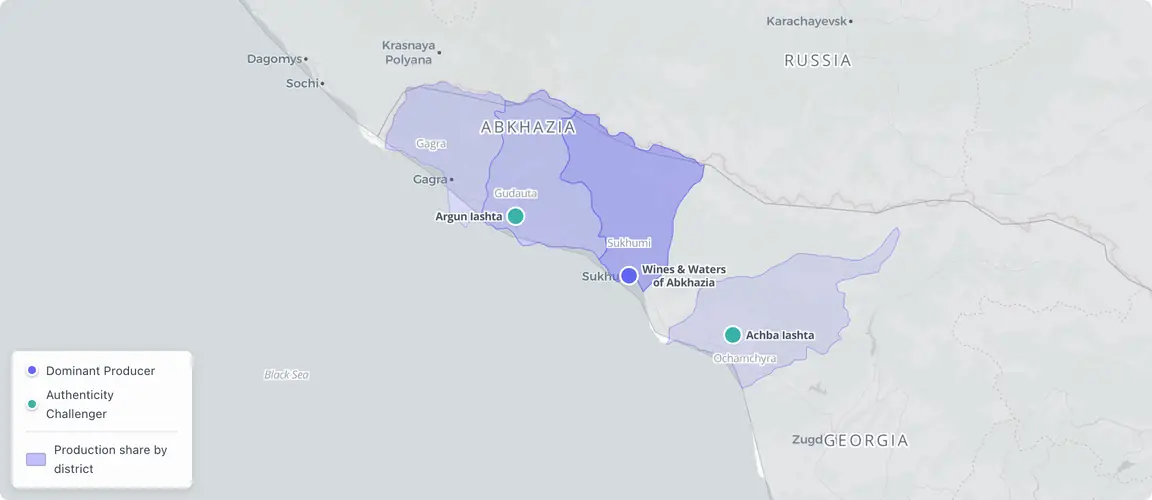
Bulk vs boutique: Abkhazia's wine geography
Brand Distribution
Survival, then the reckoning
Prince Bata Achba was executed at 96 during Stalin’s 1937 repressions. The winemaking knowledge in his family survived him — passed down until 1999, when his descendant Nikolai Achba raised $6 million to rebuild a sector that had just lost 1,400 of its 1,500 hectares to a 413-day war, betting the family’s entire future on a Russian market that did not yet exist. That market arrived in 2008. By 2025, the Achba enterprises alone produce over 22 million bottles a year — and the general director who built that empire is now the one publicly admitting the sector has a problem the war never taught him to solve.
From ancient clay to Kremlin tables
In all of Abkhazia, only 5–6 enterprises produce wine.
Abkhazian wine traces an unbroken lineage to 3000–2000 BCE, evidenced by Bronze Age settlements at Bombora in Gudauta District where archaeologists uncovered winemaking tools and the “wine-drinking statue” that still graces modern labels. That 4,000-year continuity is embedded in the country’s very name — Apsny, “Land of the Soul,” with wine as the liquid essence of that soul.
The Soviet era (1920–1991) was wine’s industrial zenith. Abkhazia became one of the wealthiest Soviet regions, its 1,500 hectares of vineyards producing wines that graced Kremlin tables — the 1962 launch of Lykhny, a ruby-red Isabella favoured by Brezhnev, Mikoyan, and Kosygin, marked the peak. Wines and Waters of Abkhazia (founded 1930) managed 22 tea factories alongside wine production and generated hard currency through exports to the socialist bloc.
The Achba dynasty runs through this history like a vine through trelliswork — its winemaking lineage predates Soviet industrialisation and survived Bata Achba’s execution in 1937 because knowledge, unlike vineyards, cannot be shelled. Said Achba, the fourth generation, recalled the postwar starting point: “We started with 10,000 bottles.” Not a single hectare of industrial vineyard was left standing; what the family had instead was transmitted technique — pruning, fermentation timing, which slopes held moisture — none of it written down, all of it intact.
This golden age collapsed brutally between 1989 and 1993. Georgian forces crossing the Ingur River in August 1992 sparked 413 days of war that killed 10,000–15,000 and caused $11.5 billion in damage. All 22 tea factories were destroyed; vineyards shrank from 1,500 hectares to roughly 100; wine production ceased completely. The 1994–1998 period was the sector’s death agony, survived only because the Achba family preserved winemaking knowledge when every rational incentive pointed toward abandonment. Nikolai Achba’s 1999 decision to raise $6 million for reconstruction — Italian and French equipment, 2.5 million bottle capacity — bet the sector’s entire future on a Russian market that didn’t yet exist. That market materialised through the August 2008 Russo-Georgian War: Russian recognition opened access, while Georgia’s retaliatory Law on Occupied Territories permanently blocked Western markets. What looked like strategic catastrophe became opportunity for producers who had already survived the worst.
Five districts, one survival strategy
Abkhazian wine production concentrates in five districts, each performing a distinct function rather than competing head-on. Sukhumi dominates at 40–45% of output: the Wines and Waters of Abkhazia (W&WA) factory here, rebuilt in 1999 with Italian and French equipment, has port access for direct shipping to Russian Black Sea harbours and 20–28 million bottles of annual capacity — far beyond what its own 600 hectares of vineyard can supply. Gudauta (25–30%) plays the opposite role: genetic preservation. Its cooler, Caucasus-sheltered microclimate let family-tended vines survive the war essentially by being ignored, creating an accidental gene bank that Argun Iashta now draws on for Kachich and other heritage varieties. Pitsunda-Gagra (15–20%) is the premium bet — Chateau Abkhaz’s €50 million, 400-hectare estate targets ripening seasons long enough for Malbec and Cabernet. Ochamchyra (10–15%) is where authenticity is being tested at scale: the newly opened Achba Iashta winery, 685 million roubles invested, uses exclusively Abkhazian-grown grapes. Gali (5–10%), the most war-damaged and still politically contested district, contributes only uncommercialised household production — but its families preserved genetic material that quality-focused wineries now draw on.
This regional division of labour explains how a war-devastated sector rebuilt Russian market share without single-region dominance. What it does not explain is the gap between vineyard capacity and bottled output — that requires understanding what actually goes into the bottles.
The authenticity question
Nikolai Achba, General Director of Wines and Waters of Abkhazia, stated in August 2025 that “In all of Abkhazia, only 5–6 enterprises produce wine.” This is a striking admission from the man who controls the dominant producer. The figure of “90 wineries” that circulates in tourism literature conflates household producers—many making wine in buried clay vessels for family consumption—with commercial entities operating at scale.
The deeper structural issue is what those 5–6 enterprises actually bottle. W&WA’s 600–700 hectares yield roughly five million bottles a year against a factory capacity of 20–28 million — the gap filled by imported bulk wine, primarily Moldovan and increasingly Argentinian, trucked in by tanker. Multiple sources place imported bulk material at 70–90% of W&WA’s total volume; as Echo of the Caucasus put it, “Without imported wine material, Abkhazia’s wine industry cannot function.” This creates a paradox: the nine heritage brandlines most Russian consumers associate with Abkhazian wine are all under that single brand, and most of their volume comes from grapes grown elsewhere. The “counterfeit crisis” Russian media discusses is really two problems — outright fraud (Moldovan bulk bottled with misspelled Abkhazian labels) and something subtler: the dominant legitimate producer itself bottling mostly imported wine under heritage labels that evoke 4,000 years of local tradition.
That vulnerability was exposed in January 2024, when the Abkhazian government imposed a 30% excise on imported wine materials. W&WA production halted for over a month; 300 workers were idled. The excise was reversed within roughly ten days of public pressure, but the episode revealed how completely the flagship industry depends on a supply chain it does not control.
Roskachestvo, Russia’s national wine quality authority, does not cover Abkhazian wines at all — it evaluates only Russian production. The Russian Ministry of Finance estimates 16.4% of all grape wine on the Russian market is counterfeit or illegal; without institutional verification, consumers have no reliable way to tell authentic Abkhazian wine from bulk imports wearing local labels.
The sector the world forgot
Most observers assumed Abkhazia’s wine industry died during the 1992–1993 war—if they knew it existed at all. The reality through 2023: a sector that survived total devastation, converted international isolation into strategic advantage, and built significant market share in Russia. At its peak, Abkhazian wine commanded roughly 10.4% of Russia’s wine import market, placing it fifth among all import sources.
The perception gap stems from multiple reinforcing barriers. Complete political isolation means only five nations recognise Abkhazian independence (Russia, Nicaragua, Venezuela, Nauru, Syria), creating diplomatic invisibility that extends to commercial awareness. Georgian Occupied Territories Law criminalises trade with Abkhazia, threatening 4–8 years imprisonment for violations—effectively blocking Western market access even for buyers willing to ignore diplomatic non-recognition. Financial infrastructure foreclosure operates through international banks avoiding transactions to prevent sanctions violations, SWIFT blocking Abkhazian participants, and credit card networks refusing merchant processing.
These barriers concentrated all commercial energy on a single market. When that market shifted, Abkhazia had no alternatives.
When European wine disappeared
The original version of this analysis, published in November 2025, predicted that Russia’s 2024 tariff increases on “unfriendly countries” wines would create a windfall for Abkhazian producers. The prediction was wrong—not because the tariffs didn’t work, but because three converging forces hit Abkhazia harder than the tariffs helped.
What actually happened to EU wines
Russian tariff increases in 2024 (from 20% to 25%, minimum $2/litre) did damage European wine imports, but the decline was approximately 50–60% cumulatively—not the 90% figure cited in the earlier version, which traced to a single uncorroborated market research report. EU wines hit a 20-year low: Italian imports fell 28%, Spanish 29%, French 31%, Portuguese 26%. Total wine imports to Russia declined roughly 11% in the first nine months of 2024, with “unfriendly nation” imports down 21%.
The market share vacated by European wines was captured—but not by Abkhazia. Georgia expanded to 9.51% of Russia’s total wine market. Chile reached 3.99%. South Africa hit 3.05%. Russian domestic production surged 20.8% in 2024. The Fort Wine Company, a major Russian industry player, observed that the under-1,000-ruble price segment is now “almost completely occupied by Russian products.” Abkhazian wines—Lykhny retails at 600–700 rubles—compete directly in that segment.
Three shocks in eighteen months
The first shock was the self-inflicted January 2024 excise, above — the clearest signal that Abkhazia’s flagship producer could be shut down by a single domestic policy decision. The second came from Moscow: in May 2024, Russia tripled its wine excise from 34 to 108 rubles per litre, hitting budget-segment wines hardest — precisely where Abkhazian brands compete. A 600-ruble bottle of Lykhny has fundamentally different price elasticity from a 2,000-ruble Chianti: Russian consumers trading down from European wines found cheaper Russian alternatives, while those trading up from Abkhazian wines found Georgian and Chilean options at similar or lower prices. The third shock was competitive — Georgia, the very country that criminalises trade with Abkhazia, captured the largest share of the EU vacuum, backed by international recognition, institutional quality frameworks, and a “cradle of wine” brand narrative Abkhazia cannot match.
The numbers
Abkhazian wine imports to Russia fell approximately seven million litres in 2024 compared to 2023. Abkhazian sparkling wine sales collapsed 49.5% in January–July 2025. Abkhazia’s share of Russia’s total wine market dropped to 1.75%, ranking ninth—behind Russia itself (60%), Georgia (9.51%), Italy (5.47%), Spain (4.41%), Chile (3.99%), South Africa (3.05%), Portugal (2.98%), and France (2.01%). In an ironic reversal, Abkhazia actually became a buyer of Russian wine in 2024, receiving 13% of Russia’s wine exports (ranked third among destinations).
Who survived, and how
The 2023 national wine competition received 95 samples from 47 winemakers, of which fewer than half passed laboratory testing — a reminder that below the commercial tier, quality varies enormously.
The dominant producer
Wines and Waters of Abkhazia (founded 1930) remains the overwhelming force. Nine heritage brandlines—Lykhny, Apsny, Psou, Anakopia, Bouquet of Abkhazia, Eshera, Amra, Novy Afon Cahors, and Abkhazian Sparkling—account for most of what Russian consumers know as “Abkhazian wine.” Capacity reaches 20–28 million bottles per year, built on Achba-family knowledge preserved through the 1994–1998 dark years and the 1999 reconstruction. But the dominance rests on a fragile foundation: its own 600–700 hectares supply perhaps a quarter of production, the rest imported bulk — a dependence exposed by the January 2024 excise and one that complicates the heritage narrative justifying premium pricing. In 2016, Beslan Agrba—founder of Mistral Trading (branded rice, 6.7 billion rubles revenue) and Mistral Alko (Russia’s former top wine importer by volume)—consolidated a 50% stake in W&WA, purchasing 40% from Levan Tujba for approximately 280 million rubles, bringing 54,000+ retail points across 160+ Russian cities but tethering the producer more tightly to the budget segment where Russian domestic wines are now winning.
The authenticity challengers
Argun Iashta (founded 2014 by Alkhas Argun, also CEO of mobile operator Aquafon-GSM) produces roughly 15,000 bottles at his ancestral home in Kulanyrkhva village — a rounding error against W&WA’s millions, but every bottle from locally grown grapes. “I want to make my small contribution and break the stereotype that there is no real wine in Abkhazia,” he said in 2018. In September 2024 the winery produced the first-ever commercial wine from the genetically unique Kachich grape; Nikolai Achba himself acknowledged the broader potential: “About 25 varieties are now being worked on. There are hopes that three or four will produce good winemaking results.” The FAO-funded project that might have accelerated this revival — involving Swiss researcher Tiphaine Lucas and links to the Bordeaux Institute and Montpellier Laboratory — was shut down in September 2022 when Abkhazia’s Foreign Ministry declared Lucas persona non grata on espionage suspicion, terminating the only institutional pathway for indigenous grape preservation.
Achba Iashta (opened 2025, Labra village) received 685 million rubles in Russian-Abkhazian preferential credit for 800,000 bottles of annual capacity, using exclusively Abkhazian-grown grapes — endorsed in person by Russia’s Minister of Economic Development. The strategic tension is extraordinary: Nikolai Achba controls both W&WA, the bulk-dependent mass producer, and Achba Iashta, the authenticity-first challenger built to prove Abkhazian wine can be made entirely from Abkhazian grapes. “There are various rumours that winemaking in Abkhazia doesn’t exist at all,” he said at the 2025 opening. “I think this will be one of those points that shows that all of this exists with us.”
Chateau Abkhaz (founded 2008) sits between the two models — its €50 million, 400-hectare integrated estate is the sector’s largest single capital commitment, and it claims to be “the only producer on the territory of Abkhazia whose production is based on their own distillates.”
Below commercial scale, a handful of micro-producers (Wine Jet Abkhazia’s tourism-oriented 20,000 bottles; W&WA’s religious-tourism Novy Afon Cahors line) and hundreds of household producers round out the sector — the latter maintaining buried-clay-vessel traditions that saved indigenous varieties during the 1992–1998 collapse and now supply genetics to the quality-focused wineries above.
How the wine moves
Abkhazian wine reaches Russian consumers through three channels. Black Sea maritime trade dominates — container ships from Sukhumi and Gagra reach Novorossiysk and Sochi directly, avoiding Georgian territory entirely, which is why port infrastructure (not terroir) explains Sukhumi District’s production dominance. A smaller land corridor trucks wine across the Psou River into Krasnodar for distribution to Moscow and St. Petersburg, though checkpoint delays create counterfeit entry opportunities; a February 2025 test flight signalled possible air freight for premium wines. Diaspora networks — ethnic Abkhaz communities in Russia — handle under 5% of volume but generate disproportionate brand loyalty at premium prices.
Retail distribution follows standard Russian FMCG cash-and-carry models, with Mistral Alko’s 54,000+ retail points across 160+ cities giving W&WA a distribution depth no other Abkhazian producer matches. Beyond Russia, the same isolation barriers named above hold: zero evidence of Abkhazian wine exports to the UAE, China, or Turkey.
A factor invisible in trade statistics: Abkhazia’s electricity crisis directly affects production. Cryptocurrency mining consumed roughly half of available power before October 2025 legislation allowed equipment confiscation (4,000+ devices seized); by December 2024, residential power was down to under three hours a day after the Inguri hydroelectric plant stopped supplying it. Wineries requiring refrigeration and fermentation control operate under conditions no competitor faces.
The wine that means homeland
The Abkhazian name for their homeland, Apsny, translates as “Country of the Soul” — and wine is treated as that soul’s liquid form, not as marketing metaphor. It explains behaviour that looks economically irrational: the Achba family preserving winemaking knowledge through 1994–1998 when no markets existed, and hundreds of household producers maintaining buried-clay-vessel traditions for family consumption when commercial sale would have brought needed income. The traditional atsatsa banquet ritualises the role — wine toasts in prescribed order, first to God, then homeland, fallen warriors, elders, family, ancestors — and roughly 500,000 ethnic Abkhaz living outside Abkhazia (in Russia, Turkey, Syria, Jordan) treat a bottle bought in Moscow or Istanbul as portable proof of homeland connection. The 4,000-year continuity narrative also does double duty as geopolitical argument, positioning Abkhazian winemaking as older than Georgia’s competing heritage claim.
What war teaches—and what it doesn’t
Abkhazia’s wine sector proved that founders who survive impossible conditions build something competitors cannot easily replicate. Thirty years of isolation, a devastating war, and the loss of every market except one produced a concentrated, resilient industry. That much remains true.
What war did not teach was how to compete in a normalising market. The sector’s crisis-era advantages—captive Russian demand, absence of alternatives, emotional purchasing by a sympathetic consumer base—are eroding. Russian domestic production is surging. Georgian wines are capturing the shelf space Abkhazians expected to claim. The budget segment where W&WA competes is increasingly crowded.
The corrected outlook is neither the triumphalist narrative of a year ago nor a story of decline. It is a sector at an inflection point. The bulk-dependent model that rebuilt the industry from ruins has reached its structural limits. Excise volatility, import dependence, and rising competition have exposed its fragility.
Three producers are testing the authenticity equation from different angles. Argun Iashta is doing it at artisanal scale with indigenous grapes—15,000 bottles made from varieties that exist nowhere else on earth. Achba Iashta is attempting it at near-industrial scale with exclusively Abkhazian-grown grapes and 685 million rubles of Russian credit. Chateau Abkhaz claims integrated production from its own plantations. Each represents a different bet on whether authentic Abkhazian wine—made from Abkhazian grapes, grown in Abkhazian soil—can compete in a market that until now has been perfectly happy buying Moldovan bulk in Abkhazian bottles.
The irony Argun set out to fight in 2018 contains a grain of uncomfortable truth: most of what Russia drinks as “Abkhazian wine” is not, strictly speaking, Abkhazian. The producers making it Abkhazian—from root to bottle—are the ones building something the market has not yet had to reckon with.
The sector that survived total war now faces its real test: not whether it can endure destruction, but whether it can build something genuine from what remains.