 Skip to main content
The Island That Could Not Become a Port
For nearly four hundred years, Ilha de Moçambique was the obligatory waystation between Lisbon and Goa — the hinge on which Portugal's Asian empire pivoted. Then the Suez Canal opened in 1869. Steamships needed deep harbours the coral island could not provide. In 1898 the capital moved south. The island did not pivot. It is UNESCO-listed now.
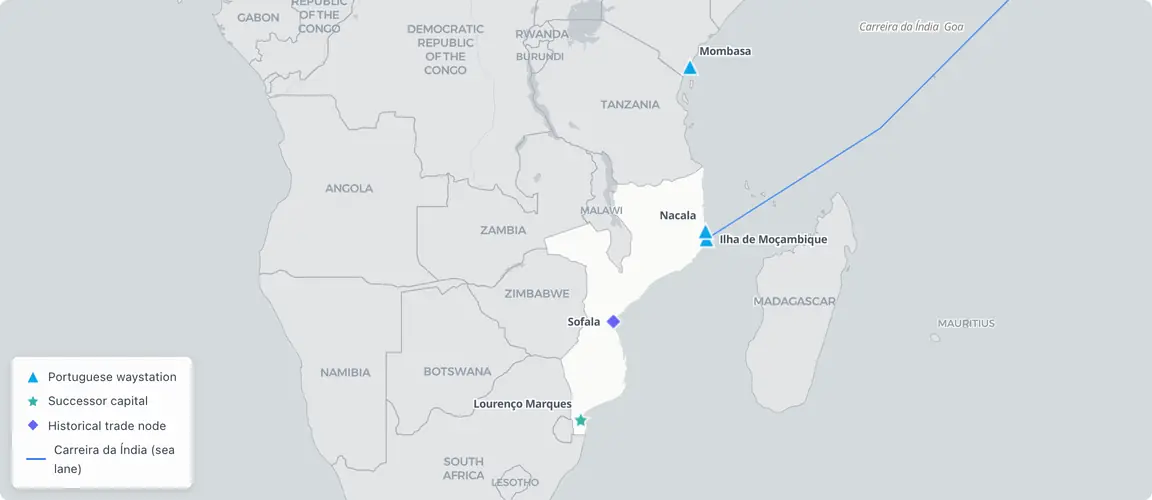
Geographic context: Ilha de Moçambique and the Carreira da Índia
Trade timeline
On 1 December 1898, a colonial decree transferred the capital of Portuguese Mozambique from Ilha de Moçambique to Lourenço Marques. The island had held the title for 391 years. The order was not controversial. By 1898, it was simply recognising what had been obvious since 1869: the island was no longer where the geometry of trade required things to happen.
The crumbling buildings of Stone Town are beautiful. They are also the most precise record available of what happens when a strategic asset becomes a heritage asset — and when the two happen in a single human lifetime.
The island at the hinge of empires
The Portuguese fort that is so prominent in the World Heritage narrative is less significant in heritage terms to the people living on the island.
Ilha de Moçambique’s story begins not with Portugal but with the Indian Ocean. Before Vasco da Gama arrived, the island’s sheltered anchorage at the mouth of Mossuril Bay was already a trading post of the Swahili world — a node in the network that moved gold from the Zimbabwe plateau and ivory from the interior to the Persian Gulf, India, and China. The local sultan, Mussa Bin Bique (Ali Musa Mbiki), controlled trade as a vassal of the Kilwa-area lineages. Archaeological evidence places the urban settlement no later than the 14th century.
Da Gama arrived on 2 March 1498. He was identified as a Christian, fired upon, and left the island firing cannon in return. Portugal returned in force. In 1507, Francisco de Almeida established a port and naval base on the island, displacing the sultanate and beginning the fortification of the coral rock. The decision that followed — to make Ilha de Moçambique the mandatory waystation for the Carreira da Índia, Portugal’s annual Lisbon-Goa armada — was not arbitrary. It was the only rational response to the physics of sixteenth-century sailing.
The logistics of the India Run were unforgiving. Ships had to round the Cape of Good Hope by mid-July, reach Mozambique Island by mid-to-late August to refit and resupply, and depart before approximately 25 August to catch the southwest monsoon to Anjediva and Cochin. Miss the window and a ship lost an entire year. Between 1497 and 1650 there were 1,033 departures from Lisbon for the India Run — and the island was the sole sheltered anchorage on the African side capable of serving the carrack-and-galleon fleets. The coral island itself was dry; water and provisions were ferried in from the Mossuril Bay mainland. None of that mattered. The island was where the geometry of sail required ships to be, and so ships went there.
Mozambique — the country — is named for this island. That is how important it once was.
The coral fortress
The Chapel of Nossa Senhora de Baluarte (“Our Lady of the Bastion”) was completed in 1522. It is the oldest European building still standing in the southern hemisphere — a small, austere structure of coral lime that has outlasted every political order that raised or demolished things around it. Thirty-six years later, construction began on Fort São Sebastião, to a design by Italian-Renaissance military engineers who understood the geometry of cannon angles better than of coral foundations. The fort took roughly fifty years to complete. It is the oldest complete bastion-style fort still standing anywhere in sub-Saharan Africa.
Both buildings had to be durable. Ilha de Moçambique attracted enemies.
In 1607 and again in 1608, the Dutch East India Company — then at the peak of its ambition to break the Portuguese monopoly on the Asia trade — sent fleets to take the island. Captain-General Dom Estêvão de Ataíde held the fort both times. The English historian Edgar Prestage argued that this defence “saved, not only the fortress itself, but Portuguese rule in the East including East Africa.” The claim is large but not absurd. The island controlled the passage; without the fort, the passage would have changed hands.
The Omani threat was more sustained. The Ya’rubi dynasty, consolidating its power across the Persian Gulf and Indian Ocean, began rolling back Portuguese East Africa from the north. Zanzibar fell in 1652. Mombasa was raided in 1661. In 1671, Omani forces sacked Mozambique Island itself — the fort held, but the damage to the town was severe. By 1698, after a three-year siege, the Omanis took Fort Jesus at Mombasa. Portugal effectively retreated south of Cape Delgado. Ilha de Moçambique became the new northern limit of Portuguese influence — a function of subtraction rather than expansion. The island’s importance, paradoxically, grew from what surrounded it having been taken.
In 1752, Mozambique was detached from the Estado da Índia and given its own captaincy-general, reporting directly to Lisbon. It was now the capital of an autonomous Portuguese East African territory, not simply a naval waystation for a larger empire.
The merchants of a thousand flags
The eighteenth and early nineteenth centuries were, paradoxically, the island’s commercial peak. The Carreira da Índia was declining — fewer armadas, smaller ships — but a new commercial logic had arrived.
Gujarati Vāniyā (“वाणिया”) merchants from Diu and Daman had established themselves as the credit backbone of the island’s commerce. In Pedro Machado’s Ocean of Trade (Cambridge, 2014), they had “virtually underwrote the expansion of slaving through their dominance of the textile trade… and made possible the complex multilateral payments that were required in both the slave and the ivory trade.” By the 1760s, the Yao ivory caravans delivered up to 325,000 pounds of ivory annually to the island. A Diu merchant named Ponja Velgi led the commercial community. The island itself was cosmopolitan to an extraordinary degree: Portuguese officials and mestiço prazo-holders; Catholic Goans; Hindu and Jain Vāniyā from Diu; Sunni Swahili-Mwani from Arab lineages; enslaved Africans from the Makua, Yao, and Zambezi hinterlands.
The slave trade was what drove the century’s prosperity — and it is the ugliest part of the record. After French Mascarene plantations and Brazilian sugar and coffee estates expanded their demand in the 1780s, and after British naval enforcement in West Africa diverted slavers to East African routes, Ilha de Moçambique became the primary export node for what José Capela documented as roughly 400,000 enslaved people shipped from Mozambique ports to Brazil between 1800 and 1865. Patrick Harries records the peak as 1789–90, when approximately 46 ships carrying more than 16,000 enslaved people circumnavigated the Cape — most clearing through the island.
The 1877 neoclassical hospital — for a time the largest hospital in sub-Saharan Africa — was built in this era of paradoxical prosperity. The island was being improved at the same moment that the system supporting it was beginning to fracture.
The canal that changed everything
The crisis was not a single event. It was a thirty-year compounding shock, each element comprehensible in isolation, together catastrophic.
On 17 November 1869, the Suez Canal opened. The passage reduced the Arabian Sea-to-London journey by approximately 8,900 kilometres and shifted the trunk route between Europe and Asia definitively off the Cape of Good Hope. Ships that had needed Mozambique Island as a waystation — ships that had to be there, by the iron logic of the southeast and southwest monsoons — no longer needed the Cape at all.
But the Canal alone would not have finished Ilha de Moçambique. What finished it was the technology that came with the Canal.
Steam power had been advancing since the 1840s. By the 1860s and 1870s, oceangoing steamships were replacing sail on the major commercial routes. Steamships did not need monsoon windows. They did not need the specific anchorage geometry that had made the coral island indispensable. They needed something else: deep water and coaling capacity. The island had neither. Mossuril Bay was too shallow for the new tonnage. The coral-fringed approaches, perfectly suited to the draught of sailing carracks and frigates, were a structural disqualification for vessels that drew four to six metres.
The island’s physical constraints — 1.5 square kilometres of coral, no agricultural hinterland, no developable land, no deep water — had never mattered when sail technology made the location indispensable. They mattered enormously when it did not.
The Witwatersrand gold rush of 1886 accelerated the shift. Lourenço Marques, 2,500 kilometres south on Maputo Bay — a deep, well-protected harbour with rail access to the Transvaal from 1895 — became economically dominant. On 10 November 1887 it was elevated to city status. On 1 December 1898, by colonial decree, Lourenço Marques replaced Ilha de Moçambique as capital of Portuguese Mozambique. The administrative bureaucracy completed its move south by 1907. In October 1951, the port of Nacala opened — a deep-water harbour reaching sixty metres depth, with a 912-kilometre railway to the interior — absorbing what shipping remained in northern Mozambique.
The island did not pivot because it could not pivot. No investment in dredging or coaling infrastructure could overcome a coral atoll’s physical ceiling. The geographic asset that had been indispensable to one technology was architecturally incompatible with the next.
The 29-year window between the Suez Canal opening (1869) and the capital moving (1898) is the most instructive element of this story. Those three decades were not quiet — the decline was visible, Lourenço Marques and Beira were being built up, the merchants of the island debated reforms. But the reforms available to the island were at the margin. The thing that made it valuable could not be changed.
Elsewhere on the Mozambique coast, deep-water alternatives were being built precisely because the island could not adapt. Beira, at the mouth of the Pungwe River, was founded as a colonial town in 1887 and connected by railway to what is now Zimbabwe by 1900. Lourenço Marques had its railway to Pretoria by 1895. The empire was not failing to invest in Mozambican infrastructure; it was investing in the infrastructure that worked. The island was not left behind through neglect. It was left behind because its geography, the source of its four-century dominance, set a ceiling that no investment could raise.
What strategic position is made of
UNESCO inscribed Ilha de Moçambique in 1991 under criteria iv and vi, citing its architectural unity and its testimony to the encounter of Bantu, Swahili, Arab, Persian, Indian, and European cultures over four centuries. The inscription froze the island at the moment of its relevance — which was, in practice, the moment just before its relevance ended. What UNESCO preserved was the perfect record of a strategic asset at the point it became a heritage asset.
But even that framing is contested. Jonathan Sharfman, a heritage researcher at the Dhakira Center for Heritage Studies at NYU Abu Dhabi, has noted that “the Portuguese fort that is so prominent in the World Heritage narrative is less significant in heritage terms to the people living on the island.” The residents of Macuti Town — the southern vernacular quarter of palm-thatch and coral where the fishing community has lived since the colonial era ended — identify their heritage with the Mwani maritime culture that preceded the Portuguese and survived them. The 14,000 people who remain on 1.5 square kilometres of coral are not curating a museum. They are living in a city whose original commercial rationale expired in 1898.
The lesson is about the nature of strategic position.
For 360 years, Ilha de Moçambique was genuinely indispensable. Not advantaged, not well-positioned — indispensable. Ships had to be there. The location was not a preference but a physical constraint imposed by the geometry of monsoon sailing. That is as strong a competitive position as any business has ever held: customers could not reach their destination without you.
The question the island’s story forces is: what was that position made of? The answer is precise — it was made of the interaction between geography and a specific technology. The coral anchorage was indispensable to sail-era carracks navigating the southeast monsoon. Change the technology and the indispensability evaporated. The geography remains identical; what it is worth is entirely different.
Three moments existed when adaptation might theoretically have been possible. In the 1850s and 1860s, before the Suez Canal opened, the colony could have invested in mainland coaling depots, dredging at Mossuril Bay, and rail to the interior. It did not — Lisbon’s attention was elsewhere. Between 1869 and 1898, after Suez, the geography’s ceiling was real: no deep-water harbour was achievable on a coral atoll regardless of investment. After 1898, UNESCO’s 1991 inscription created the conditions for a heritage-economy pivot, but tourism has been throttled by remoteness, infrastructure, and cyclone risk — Cyclone Jokwe in 2008, Cyclone Chiado in 2024, Cyclone June in March 2025.
The operational lesson is not that you cannot survive technological disruption. It is that the time to audit your defensibility is when you are dominant, not when you are declining. Ask what your competitive position is actually made of. If the answer includes the phrase “because of a specific technology” — a specific platform, a specific distribution channel, a specific regulatory regime, a specific hardware standard — then assume it is rented, not owned. The lease will expire.
The window between when a disruptive technology arrives and when it formally kills the old advantage is almost always measurable. The Suez Canal to the capital move was 29 years. In modern compressed timescales, that window is shorter. But it is almost always open for some period. The only question is whether you use it as the moment to pivot — or as the last comfortable years of an arrangement you do not want to examine too closely.
Ilha de Moçambique is a UNESCO World Heritage Site of great beauty. The crumbling coral buildings of Stone Town are worth the journey. But the island’s most durable legacy is the 29-year window that nobody used.
Researched 20 sources in English, Portuguese.