 Skip to main content
Malaysia Bakery: The Founders' Last Handoff
Most Malaysians assume Secret Recipe is a foreign import. It was built in 1997 — the year the Asian Financial Crisis hit — by a Kelantan marketing man with RM150,000 and three baker nephews. That misread runs through the sector: a category treated as corporate was hand-built by a tiny founder cohort now handing it over at once.
Malaysia's bakery cohort: a west-coast cluster
The founder era, institutionalised or dissolved
The maroon-boxed cheesecake sits on birthday tables across the country, the café anchors mall after mall, and the brand name has the faint gloss of somewhere else — somewhere with rounder moons. So nearly everyone files Secret Recipe under foreign import. It is not. It was built in 1997, the year the Asian Financial Crisis detonated across the region, by a Kelantan-born former marketing executive named Steven Sim, with RM150,000 and three of his baker nephews. One Chinese-language profile put the misperception plainly: the foreign moon is rounder. Malaysians had simply assumed their own.
That misread runs through the entire sector. A category Malaysians treat as ambient and corporate — bread, cake, coffee, the furniture of ordinary life — was in fact hand-built by a tiny cohort of crisis-tested founders, most of them Chinese-Malaysian, baking and selling directly through vertically integrated cafés. There are perhaps eight to twelve of them that genuinely qualify, once the listed conglomerates are filtered out. And in 2024 through 2026, that whole cohort arrived, together, at the moment it hands the business over.
The cohort nobody assembled
A 25kg sack which previously sold for RM45 was now priced at RM65. If this is not controlled, I am afraid there will be a price increase.
To see the sector clearly you first have to subtract. Berjaya Food, listed on Bursa’s Main Market, runs Starbucks Malaysia and Paris Baguette. Focus Point, an ACE Market optical group, owns the Komugi bakery arm. BreadTalk is Singaporean; SugarBun and The Loaf are corporate. Strip those out and what remains is small enough to name on one hand and a half: Secret Recipe, Rotiboy, RT Pastry, Kenny Hills Bakers, Bread History, King’s Confectionery, Love a Loaf, Lavender — plus boundary cases like Dotty’s, half-sold in 2026.
These are not a federation. They share no trade body of consequence, no common investor, no analyst coverage worth the name. What binds them is biography. They were founded, overwhelmingly, by Chinese-Malaysian entrepreneurs who started small and stayed founder-controlled — and they were forged in the same furnace. Secret Recipe opened into the 1997 crisis. Rotiboy was a second act after a failed mushroom-farming venture. RT Pastry’s founder, a Taiwanese former BreadTalk head chef, opened in 2003 to first-day sales of RM252. The sector did not grow up in a boom. It grew up under pressure, which is exactly why it learned to integrate vertically — to bake what it sold, control its own kitchens, and survive on margin rather than scale.
Where the cohort actually lives
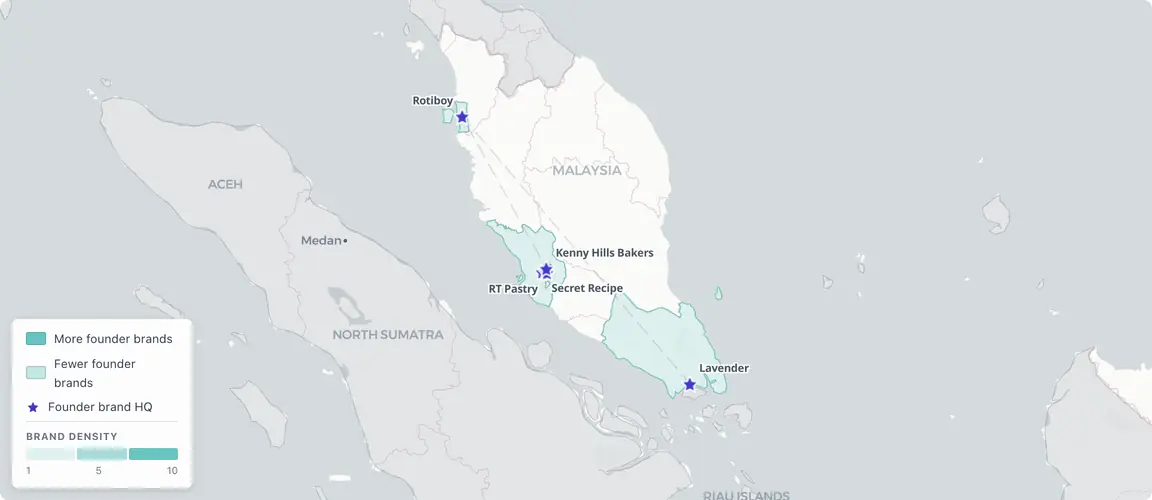
For a sector Malaysians experience as nationwide, the founder-owned core is strikingly concentrated. Roughly half of it sits in the Klang Valley — Kuala Lumpur and Petaling Jaya — where urban income, mall density, and central-kitchen logistics favour upscale-craft and mass-premium chains alike. Secret Recipe, RT Pastry, Kenny Hills, and the smaller craft entrants are all west-coast metro brands.
Penang holds about a quarter, and holds it with a different character. The north is the bakery heartland in the older sense: Rotiboy was born in Bukit Mertajam, Bread History in Georgetown, Love a Loaf in Bayan Baru. Strong Chinese-Malaysian SME culture, a tourism economy, and lower operating costs made it a launchpad for signature-product and open-bakery formats. Johor Bahru, in the deep south, contributes a thin slice — Lavender’s boutique confectionery, oriented toward Singapore demand across the causeway.
The rest of the country barely registers in founder-owned terms. East Malaysia’s bakery presence — Sabah and Sarawak — is largely franchised or corporate, an expansion frontier rather than a place these brands were born. The map of this sector is not a map of Malaysia; it is a map of one coast, and mostly of two cities on it. That concentration is itself a finding: this is a metropolitan, Chinese-Malaysian SME phenomenon wearing the costume of a national industry.
The clustering is not coincidence, and it matters for who can buy in. A central kitchen serving the Klang Valley can supply dozens of outlets within an hour’s drive; the same kitchen serving a genuinely national footprint would need duplicating. The founder cohort’s vertical-integration model — bake centrally, sell directly — is therefore a metropolitan model by design. It scales beautifully inside a dense urban spine and awkwardly beyond it, which is part of why the brands that reached for national or overseas scale, like Rotiboy, did it through manufacturing and franchising rather than by carpeting the country in cafés.
What the databases miss
Ask a global research house about Malaysian bakery and you will get a number. The broad bakery-products market was valued, in one Bursa-cited report, at RM20.64 billion for 2024. That figure is real and useless — it folds industrial sliced bread in with artisan sourdough, and tells you nothing about who owns what. The thing institutional capital actually wants to know — which of these brands is well-run, who controls them, what happens when the founder steps back — is precisely the thing no database holds.
The reasons are structural, not accidental. These are private Sdn Bhd companies. With the lone exception of RT Pastry’s brand-new listing, none file public accounts. Their founding stories, succession arrangements, and crisis decisions live in places international analysts do not look: the Companies Commission registry, and the Chinese-language business press — Sin Chew, Oriental Daily, China Press — where a Chinese-Malaysian founder’s biography is actually documented. The single most basic fact about Secret Recipe’s founder, the correct characters of his Chinese name, is rendered one way in the local Chinese press and another in the occasional English brief. The English record is not just thin. It is, in places, wrong.
Consider the texture of what hides in that gap. Rotiboy’s founder appears in English sources as “Hiro Tan” and in Chinese press as Tan Yip Hong, 陈业宏 — and the succession status of the brand, the question of who actually runs it now, is documented in Sin Chew and China Press, not in any English database. RT Pastry’s founder is rendered with two different given names across Chinese profiles; the correct characters can be settled only against the Bursa prospectus signature page now that the company has listed. One founder-owned brand in this cohort has a name that, in Chinese, collides with a completely different Singaporean company — a confusion that survives in English coverage precisely because no one cross-checks the local-language record. These are not trivia. For anyone trying to verify who controls a brand, who inherits it, or whether a “founder” interview is even about the right company, the local-language record is not colour. It is the primary source.
This is the intelligence gap. The information exists; it has simply not been assembled by anyone whose job is to price it. A reader of Malay and Chinese, able to read a registry filing, has a different — and fuller — picture of this sector than one relying on the English internet. The gap is not knowledge that cannot be had. It is knowledge nobody outside the country has bothered to collect.
Who’s still standing — and who they’re handing to
Put the survivors next to each other and the pattern is unmistakable.
RT Pastry is the sharpest case. Lu Chun-Neng, a Taiwanese national and former BreadTalk head chef, opened in 2003 to RM252 in takings, in a market where the 1997 crisis and a 1999 earthquake back home had closed hundreds of bakeries. He did not chase storefronts. He built central kitchens and ground out audited growth — revenue around RM60 million by 2024 — and then, in June 2026, did what none of his peers had: he listed. The Bursa ACE public tranche was oversubscribed 59.96 times. Crucially, the IPO was new shares only; Lu took no cash out and retained roughly 26% as controlling shareholder and CEO. This is succession as institutionalisation — bring in the public market, keep the founder’s hand on the wheel. No Euromonitor entry tells you the founder refused to sell down. The decision is the story.
Rotiboy is the survival case. Tan Yip Hong came to baking after a failed mushroom-farming venture, and the coffee-bun craze he built nearly destroyed him a second time: copycats underpriced the signature product and forced the company out of markets it had opened. A lesser operator would have defended the storefronts and lost. Sibling financing kept Rotiboy breathing while Tan did something counterintuitive — he conceded the imitable part of the business and rebuilt around the part that wasn’t. Halal-certified manufacturing, not retail footprint, became the asset; by 2012 that pivot had carried Rotiboy into Saudi Arabia and the UAE through a barrier no copycat could replicate, because JAKIM certification takes years to earn and customs officials in the Gulf actually check for it. That barrier is also auditable from the outside: JAKIM publishes its register, so a buyer can confirm in minutes which of these brands actually hold the credential and which only display the word — a distinction that separates the genuine exporters from the merely halal-friendly. The crisis was specific, the decision was specific, and the outcome — an export business where a retail business used to be — is the kind of reasoning a production-volume table cannot hold.
Secret Recipe is the orderly handoff. Sim built 360 Malaysian outlets and 500-plus globally, weathered a failed Australian venture from 2010 to 2013 by retreating rather than doubling down, and then did the rarest thing in a family business: he let go cleanly, elevating second-generation Patrick Sim to Group CEO. Kenny Hills Bakers is the craft variant of the same move — ex-filmmaker Au Tai Hon, who lost his newly opened Nam restaurant to the 2020 MCO and pivoted to a comfort-food concept, has installed his son Au Kai Zen as managing director.
Around these four sit the others, each one sentence of the same arc. King’s Confectionery, the 1973 heritage dynasty, is in second-generation hands under a heavy-asset model that has reportedly forced contraction. Dotty’s, Nadia Nasimuddin’s modern-Malay outlier, sold half itself to Cili Kampung in February 2026. Bread History and Love a Loaf anchor the Penang cluster. None of these is a directory entry. Each is a founder, a named pressure, and a decision made when quitting would have been rational.
Beyond the stereotype
It would be easy to read this as a Chinese-Malaysian story and stop there, and the demographic fact is real — the cohort is overwhelmingly Chinese-Malaysian, with Lu’s Taiwanese origin and Nadia’s Malay, Naza-family background as the telling exceptions. But the deeper texture is generational. These founders came up in an economy where a bakery was a way to feed a family and employ relatives, not a brand to be optimised for exit. The financing tells the story: Rotiboy was started on a brother’s car loan and a sister’s recipe; Secret Recipe on the labour of three baker nephews; King’s by a husband-and-wife pair at a wet-market stall. These were family undertakings before they were companies. Their children came up somewhere else — in business schools, in a Malaysia integrated into ASEAN supply chains, with a vocabulary of valuations and franchising their parents never used.
That is what makes the present moment a genuine inflection rather than a routine changing of the guard. The question every one of these families is answering, right now, is whether the thing the founder built survives contact with the way the next generation thinks. Institutionalise it, like Lu. Hand it down, like Sim. Sell a piece, like Nadia. Each is a different answer to the same question, and they are all being answered at once.
A calendar, not a trend
The timing here is not a metaphor; it is a calendar. RT Pastry listed on 29 June 2026. Dotty’s sold its half in February 2026. Patrick Sim took the Secret Recipe top job across 2024 and 2025. Au Kai Zen is in the managing director’s chair. These are not trends to watch for; they are events that have already happened, clustered inside thirty-six months.
Two forces converge in this window. The first is demographic: the founding generation, which opened its doors in the late 1990s and early 2000s, is now at the age where control passes whether or not anyone has documented how the business actually works. The second is competitive. The listed conglomerates — Berjaya, Focus Point — have consolidated founder-owned brands before, and a half-sold Dotty’s shows that pattern is active again.
What the record shows
The asset here is not the cheesecake or the coffee bun. It is the ownership transition itself — the rare years when a whole founder-built category is simultaneously in motion, before control settles into the second generation or the conglomerates. Underneath that transition sits the JAKIM-certified, central-kitchen infrastructure that took decades to build. The record of how these founders survived three crises sits in Malay and Chinese, in registry filings and community-press interviews that few outside the country have read.
RT Pastry’s prospectus is now public; the other founders’ reasoning is documented mainly in Malay- and Chinese-language sources. The cohort baked its way through the Asian Financial Crisis, a national lockdown, and a wheat shock, and it did so while the analysts who price Southeast Asian consumer brands were looking at the RM20-billion headline and the conglomerates underneath it. The first of these founders has already rung the Bursa bell. The rest are deciding, quietly, in two languages, who gets the keys.
Researched 32 sources in English, Chinese, Malay.