 Skip to main content
Russia's Jewelry and Watchmaking: Hidden Founders
Switzerland exported zero watches to Russia in January 2023. Headlines noted an absence and moved on. They missed a watchmaker with an asteroid named after him, a factory surviving on fifteen elderly workers that was now selling in fifty countries, and a jewelry empire built from nine people that had just sold for an estimated thirty billion rubles or more.
Five Crises, Six Regions: Where Russia's Jewelry Founders Built
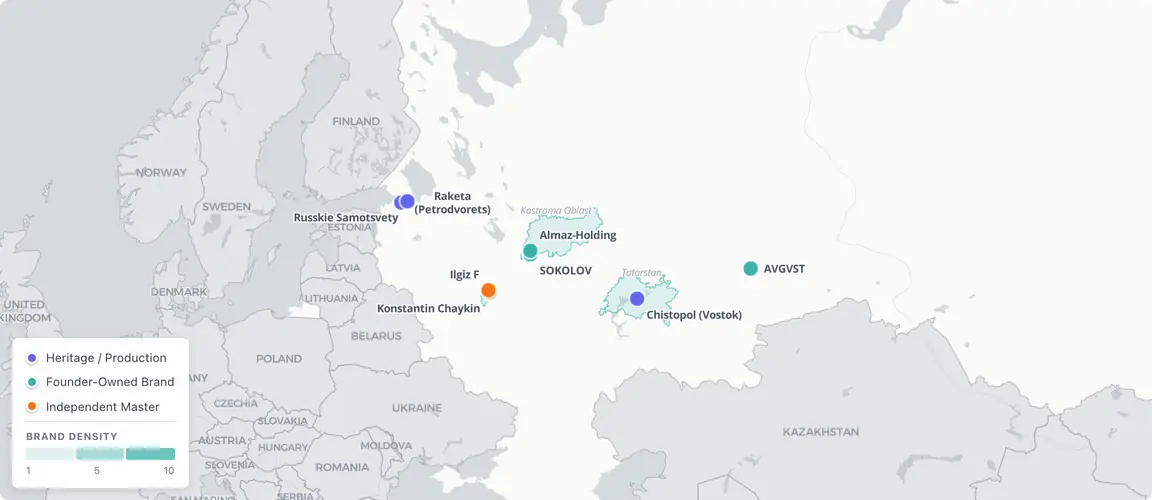
What the Swiss exit left behind
Konstantin Chaykin did not set out to become a watchmaker. He was a radio engineer who wanted a particular watch made, could not find a craftsman willing to execute his design, and built it himself instead — an origin story with no Swiss atelier, no inherited workshop, no family lineage behind it. By 2018 he had become the first Russian ever to win at the Grand Prix d’Horlogerie de Genève, the industry’s most prestigious recognition, and by 2025 a prototype of his was selling at Phillips Geneva for more than half a million Swiss francs. None of that happened because the market noticed him. It happened because he kept building regardless of whether anyone was watching.
The Swiss exits were real, and international coverage read them as the whole story. What they actually revealed was a sector that had been quietly building for decades.
Russia’s jewelry and watchmaking industry is not a story of import substitution or nationalistic consumer sentiment. It is a story of founders who built under conditions that would have ended most businesses — five successive existential crises across thirty years — and who emerged with capabilities that protected markets rarely produce. Crisis is a harsh teacher and a reliable one. The sector’s survivors know this.
The long inheritance
The whole country got cancelled — not just government, but creative businesses too.
Peter the Great established the Petrodvorets (Петродворец) lapidary factory in 1721, the same year he founded St. Petersburg. For two centuries, what would eventually become the Raketa (Ракета) watch factory served imperial Russia’s appetite for precision instruments and ornamental objects. The 19th-century craft traditions of Kostroma Oblast — where poor agricultural soil had pushed Volga peasant families into metalworking as an alternative livelihood for a millennium — produced a concentration of jewelry manufacturing that would survive everything the 20th century could deliver.
The Fabergé name traces its own arc: Carl Fabergé fled the revolution in 1918; craftsmen from the same tradition regrouped as Russkie Samotsvety (Русские Самоцветы), which continues to operate today. In 2025, SMG Capital acquired the Fabergé brand for approximately $50 million — 107 years after the founder fled, the name returned to Russian hands.
Soviet industrialization transformed artisan traditions into factory production. Watch factories established in the 1930s created technical foundations — precision tooling, caliber manufacturing, specialized materials science — that proved durable far beyond the system that built them. By 1980, Soviet production had reached a scale placing the country among the world’s largest watch manufacturers. The scale was not always quality. But the technical capacity was genuine, and much of it was located in machinery that had no direct equivalent elsewhere.
Then came 1991.
The Soviet collapse did not simply close factories. It severed the supply chains that fed them, eliminated the distribution networks that sold their products, and destroyed the pricing structures that made production economically viable. Factories that had operated for decades or centuries with guaranteed inputs and guaranteed buyers suddenly had neither. Equipment — some of it irreplaceable, calibrated to tolerances that Western manufacturers had long since abandoned as obsolete but that produced distinctive results — sat idle while asset-stripping accelerated and workforces dispersed.
This was the inheritance the revival founders received.
Five crises in thirty years
The sequence is worth understanding because it explains the character of what survived it.
The 1991 collapse was an origin event: the conditions under which post-Soviet founders had to build. Founders who succeeded in this environment did so by improvisation, personal relationships, and a tolerance for uncertainty that most business formation environments never require.
The 1998 ruble crisis — the currency lost roughly three-quarters of its value within weeks — was the first true stress test for the businesses that had emerged from the rubble. Many did not survive. The crisis also produced one of the sector’s defining origin stories: a businessman from Tatarstan who had pivoted from road construction engineering to jewelry trading stepped in to rescue a Kostroma factory from bankruptcy as its creditors gathered. The rescue was not strategically obvious. But recognizing value the market was pricing as wreckage would become the sector’s defining instinct.
The 2008 financial crisis hit Russian jewelry retail with a demand decline that was significant but recoverable. More damaging was what followed in 2014 and 2015, when Western sanctions over the annexation of Crimea combined with a halving of the ruble to push dozens of jewelry businesses into simultaneous financial distress. Several of the sector’s largest chains began the debt accumulation during this period that would eventually destroy them. The luxury market contracted.
The 2022 shock was qualitatively different from its predecessors. Western luxury brands — Cartier, Tiffany, Chopard, Swarovski, Pandora, among others — closed their Russian operations within months of each other following the Ukraine conflict. The premium segment contracted dramatically. Swiss watch exports to Russia fell to zero. At the same time, domestic tax policy changed in ways that accelerated what sanctions had begun: Federal Law 47-FZ forced all jewelry businesses off simplified taxation and onto the general system, substantially increasing the effective burden on producers of every size. The combination eliminated roughly 42 percent of the sector’s small and medium enterprises within two years. Employment in the industry, already under pressure, fell sharply. The number of registered jewelry businesses contracted by thousands.
What remained was a sector that had been tested more thoroughly than almost any other — and a set of founders who had survived every test.
The revivalists
David Henderson-Stewart is not a typical emerging-market entrepreneur. A Franco-British aristocrat with Russian ancestry, educated at Oxford and the Sorbonne, he arrived in Russia in 1997 as a lawyer. When he first visited the Petrodvorets Watch Factory — founded by Peter the Great’s imperial decree in 1721, reduced by 2010 to approximately fifteen elderly workers in a building with broken windows and unheated rooms in winter — Swiss industry advisors told him the machines were worthless. The Soviet-era equipment was too old, too removed from current manufacturing standards to be salvageable. The sensible course was to acquire the brand heritage and source production elsewhere.
Henderson-Stewart and his partner Jacques von Polier, a descendant of Russian émigrés, disagreed. They purchased the factory and began restoration without replacing the machines. The first six months of the revival, no Russian shop would accept the watches even on consignment. That it is now one of a small number of watchmakers producing its own hairsprings in-house — Monochrome Watches (February 2026) names Rolex, Patek Philippe, Bovet, Ulysse Nardin, Schwarz Etienne, Raketa, and A. Lange & Söhne among them — independent of the Swatch Group’s Nivarox supply chain that most of the industry relies on, reflects a decade of stubbornness more than capital.
Raketa watches sell in fifty countries through boutiques in Paris, Moscow, and St. Petersburg. The recovery required a refusal to do what experts recommended — to modernize the production line, to replace Soviet machines with Swiss ones, to make watches indistinguishable from the competition.
Flun Gumerov (Флун Гумеров)’s story begins in a village in Tatarstan that most Russians have never heard of. Born in 1957 in Shaychurino, the son of a peasant family, he trained as a road construction engineer and ran a construction department before pivoting to jewelry trading in the early years after the Soviet collapse. He was not a jeweler by formation. He was a builder who recognized that the Krasnoselsky Yuvelirprom (Красносельский Ювелирпром) factory — founded in 1919, one of the oldest in Russia’s primary jewelry-producing region — was worth saving when the 1998 ruble crisis brought it to the edge of bankruptcy.
The Kostroma Oblast administration asked him for help. He acquired a controlling stake and became general director. What followed was a three-decade project of industrial reconstruction that has produced a family enterprise with a 285-store retail presence and a workforce of over a thousand people. His older brother Farid runs a Kazan operation. His son Felix serves as Vice-President.
Kostroma Oblast, where both SOKOLOV (СОКОЛОВ) and Almaz-Holding (Алмаз-Холдинг) operate, produces a disproportionate share of Russia’s jewelry output despite having no deposits of precious metals. A millennium of metalworking tradition — poor soil pushed Volga peasant families into craft trades — created an industrial cluster that compounded across generations.
Building from nothing
Alexey Sokolov (Алексей Соколов)’s family has been making jewelry in Krasnoye-na-Volge for three generations. His parents and grandparents worked at the local factory. When he founded his own workshop in 1993 with his wife Elena — nine people in a home-based operation — he was building on formation that ran deep.
Growth was, by his own account, “spontaneous and chaotic.” Elena handled sales and traveled to European exhibitions to track trends. Alexey made the jewelry. In 2009, the business pivoted toward silver — a market segment his son Artem would later describe, in a Forbes Russia interview, as decisive: “Father guessed the trend — today silver is a third of the market.”
In 2014, Alexey and Elena transferred the business to their 21-year-old son and moved to Switzerland. What Artem inherited was substantial. What he built from it was different in kind. Tax disputes demanded hundreds of millions of rubles in back payment, pushing related companies into bankruptcy proceedings from which the family emerged intact. He launched a retail brand when wholesale growth plateaued, expanded to a thousand stores, and drove revenue to a level that made the company by far the largest jewelry manufacturer in Russia. Brand awareness among Russian consumers reached a figure — verified by NielsenIQ — that most consumer goods companies spend decades trying to achieve.
In August 2025, Artem Sokolov (Артём Соколов) sold the entire business — the factory, the refinery, the retail network, the brand — to a private investor with no previous experience in jewelry. He was 32 years old.
Konstantin Chaykin’s (Константин Чайкин) engineering background shaped everything that followed. He became the first and only Russian member of the Académie Horlogère des Créateurs Indépendants — the Geneva-based association of the world’s most distinguished independent watchmakers — in 2010, and served as its president from 2016 to 2019. He holds more than ninety patents, reportedly more than any other individual watchmaker globally. His “Clown” watch, unveiled at the 2018 GPHG, won the Audacity Prize wearing a face that mimicked human expression — a mechanical joke serious enough to win the industry’s most prestigious award. Asteroid 301522 bears his name.
Chaykin builds perhaps a hundred watches per year. His commercial model depends on international auction channels, collaborations with Swiss brands, and a cultural reputation that insulates him from the domestic premium market’s collapse. The ThinKing, unveiled in 2024, is the world’s thinnest mechanical wristwatch at 1.65 millimeters — a record that required both technical mastery and the refusal to accept that Russian watchmaking had a ceiling. The record is independently verified and the measurement reproducible. It is not a marketing claim. It is a measurement.
After the exits
When Western luxury brands departed in 2022, they left behind two things: a vacancy in the premium market, and a set of customers who had previously spent there. How Russian independent jewelers responded reveals something about the character the sector had developed through three decades of crises.
Natalia Bryantseva (Наталья Брянцева) founded Avgvst (АВГУСТ) in Yekaterinburg in 2013 — in the Urals, not Moscow, a choice that suggests something about the founder’s assumptions. She came from advertising, not jewelry. The brand grew through a design-forward sensibility that found buyers among a generation of Russians who wanted neither Soviet heritage aesthetics nor Western status signaling — who wanted, in short, something that could not be accused of either nostalgia or aspiration.
The 2022 crisis tested that position with unusual directness. The whole country got cancelled, she told Superfuture magazine in June of that year — not just government, but creative businesses too. The response was structural. She registered Avgvst Jewelry GmbH in Berlin, opened a flagship store on Alte Schönhauser Strasse designed with Crosby Studios, secured a partnership with SSENSE, ran a pop-up at Paris’s Palais-Royal in 2024, and distributed her team across five cities — Berlin, Moscow, Yekaterinburg, Istanbul, and Yerevan. By becoming a legally German company while maintaining Russian production, Avgvst preserved European market access while managing country-of-origin complexity that had suddenly become commercially significant.
Ilgiz Fazulzyanov (Ильгиз Фазульзянов)’s survival strategy involves no corporate restructuring. It involves making things that cannot be replicated.
He was born in 1968 in Zelenodolsk, a small city in Tatarstan, and taught himself the craft he would eventually master to a level that attracted international recognition before most of his collectors knew the country he came from. He fires enamel at temperatures 150 to 200 degrees Celsius above the conventional range, works at metal thicknesses one-tenth of the industry norm, and achieves surface qualities that other jewelers have attempted to reverse-engineer and failed.
He won the Grand Prix at the Hong Kong International Jewellery Design Excellence Award twice, in 2011 and 2013 — a repetition unprecedented in the award’s history. In 2016, he mounted a solo exhibition at the Moscow Kremlin, the first solo show by a living jeweler at the Kremlin since Carl Fabergé worked under imperial commission more than a century earlier. He maintains galleries in Paris, Geneva, Tokyo, and New York.
His commercial model is deliberately institutional. When domestic premium demand collapsed, the gallery network and museum associations held their value. When international buyers became uncertain about goods of Russian origin, the auction records at Christie’s and Sotheby’s provided their own argument. The work’s quality is, in the end, its primary protection — which is also the most durable kind.
The bifurcation question
Russian jewelry retail is, by volume and revenue, concentrating into fewer hands. Three domestic chains now command a dominant share of store count and retail revenue across the country. The mass-market segment is growing. The independent producer ecosystem has been contracting — regulatory changes in 2023 accelerated a process already underway, eliminating thousands of small businesses that lacked the compliance capacity to absorb a sudden, large increase in effective tax burden.
The independent designer scene that Bryantseva and Fazulzyanov represent is culturally significant and commercially marginal in the context of the overall market. They operate in a different register: international galleries, auction houses, export partnerships with retailers who have the context to appreciate what they are selling. The distinction matters because the two economies — mass consolidation and artisanal excellence — are not competing.
What is distinctive in the Russian case is the speed at which the consolidation is occurring and the institutional thinness — fewer galleries, fewer auction infrastructure, fewer export-support mechanisms — that makes the artisanal segment more precarious than its equivalents in older market economies.
The question is whether the audience capable of recognizing both is paying attention.
The timing question
The crisis sequence that shaped this sector is not finished. The regulatory environment that eliminated thousands of small businesses in 2023 continues to operate. The premium market that contracted when Western brands departed has not rebuilt itself. Some of the brands that survived five crises will not survive a sixth.
In 2024, the Rospatent registration of “Yakutskie Brillianty” (Якутские Бриллианты) as a geographical indication — Certificate 360, requiring Yakutian mining and cutting — signaled something beyond regulatory housekeeping. A sector that had spent decades as an afterthought in the global luxury supply chain was beginning to assert the kind of provenance claims that European luxury houses have long used as a structural advantage.
Chaykin’s asteroid was named in 2003. His GPHG win was in 2018. His Phillips auction record came in 2025. None of these moments, individually, generated sustained international attention. Taken together, they document three decades of accumulated capability.
The 2022 brand exits left a vacancy — in the premium market, in the trade press’s understanding of what Russian luxury means, in the investment and commercial intelligence about a sector that had been building quietly for thirty years. The founders profiled here did not build for this moment specifically. They built through everything that preceded it, and their capabilities were already in place when it arrived.
What the sector signals
Three centuries of jewelry-making tradition, five crises that eliminated most of the competition, and a cohort of founders who built their capabilities in conditions that few markets outside Russia have produced. The sector is not easily summarized.
What it can be, with sufficient attention, is understood. A watchmaker running one of five true full-manufacture operations in the world. A factory rescue that began with fifteen elderly workers and ended with boutiques in Paris. A radio engineer who built a record-setting caliber because no one else would. A designer who became a German company to keep selling to Europe while maintaining the production roots that gave the brand its character. An enamel master firing at temperatures that most jewelers consider impossible, in a city that most collectors could not locate on a map.
These are not emerging brands waiting to be discovered. They are established practitioners of their crafts, tested by conditions that would have ended less resilient businesses, operating in a sector that the world has largely not looked at because the assumption that there was nothing to see came so easily.
The assumption was wrong.