 Skip to main content
Srirangapatna: Capability Without Coalition
Tipu Sultan died defending his walls on 4 May 1799 — killed by a coalition he could never match despite out-innovating the British in rockets, trade, and silk. His iron-cased rockets became the “rockets' red glare” of the U.S. anthem. His Chinese silkworms became a ₹332-crore industry. The lesson is structural: capability without coalition does not survive.
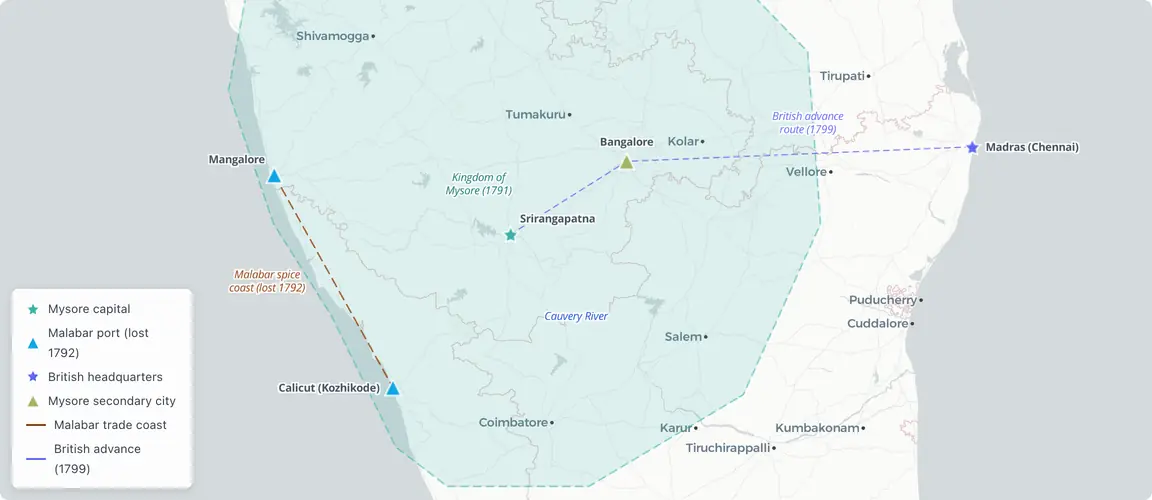
Geographic context: Srirangapatna and Mysore's commercial reach
Trade timeline
On 13 September 1814, Francis Scott Key watched the bombardment of Fort McHenry from the deck of a British sloop in Baltimore Harbour. The rockets he described in his poem — “the rockets’ red glare, the bombs bursting in air” — were Congreve rockets, named after the British artillery officer William Congreve who had refined and industrialised them. What the poem does not say, because Key had no way of knowing it, was that those rockets were Mysorean in design. They had been reverse-engineered from specimens captured at the fall of Srirangapatna fifteen years earlier, on 4 May 1799, when a British assault force crossed a four-foot-deep ford of the Cauvery River and breached a wall that had held three previous armies. The man who had invented them, Tipu Sultan, died near the Water Gate that afternoon. The rockets outlasted him by a generation.
The island that built rockets
Srirangapatna is a river island two kilometres long and less than one kilometre wide, sitting in a bend of the Cauvery where it drops off the Deccan plateau toward the sea. It entered recorded history in 894 CE, when a Western Ganga vassal named Tirumalaiah consecrated the Sri Ranganathaswamy Temple there — an act of devotion that would make the island a Vaishnava pilgrimage site for a thousand years across every subsequent regime change. The Wodeyar kings made it their capital in 1610; Kanthirava Narasaraja Wodeyar rebuilt the fort in stone in 1654. What made the island strategically decisive was not its holiness but its geography: it commanded the Cauvery crossings that connected the Mysore plateau to the Malabar Coast in the west and the Coromandel plains in the east.
Hyder Ali, a soldier of fortune who had risen through the Wodeyar army, displaced the dynasty in 1761 and transformed Mysore into something new: a French-trained military-fiscal state with an explicit commercial strategy. He seized Malabar from 1766 onward, capturing the spice ports that the East India Company depended on. By 1779 Mysore controlled roughly 80,000 square miles. When Hyder died of cancer in December 1782, his son Tipu Sultan, then thirty-one, took the throne and spent the next seventeen years building what was, by most available evidence, the most systematically innovative state in late-18th-century Asia.
The innovations came on multiple vectors simultaneously. The rocket corps, codified in the Fathul Mujahidin tactical manual, eventually reached a strength of approximately 5,000 rocket men. What distinguished Mysorean rockets from European equivalents was the casing: iron tubes rather than bamboo, which allowed gunpowder to be packed to greater densities and produced sustained pressures that drove ranges to 1,000 yards or more — superior to anything then fielded in Europe. The rockets were attached to bamboo poles for stabilisation and launched from iron frames; Narasimha’s 1985 technical study at the National Aerospace Laboratories confirmed that Indian iron quality at the period exceeded British counterparts, making the performance advantage a materials science problem as much as a military one.
The commercial state was equally ambitious. Tipu established a public-shareholding trading company with 30 inland factories — at Bangalore, Channapatna, Bidnur, Srirangapatna itself — and 17 abroad: Muscat (the largest), Jeddah, Hormuz, Pegu, and more. From 1785 he placed pepper, sandalwood, cardamom, betel nut, coconut, teak, sugar, salt, iron and elephants under crown monopoly. At Muscat, Mysorean merchants paid 4% import duty; most Indian merchants paid 8%; European traders paid 5%. This was deliberate industrial policy — a competitive subsidy to the home producer, enforced by sovereign authority.
Then in April 1786 he wrote a letter to his factor at Muscat instructing him to locate Chinese silkworm eggs and rearers. The resulting sericulture project seeded 18 to 21 centres across Mysore. The project’s output — what mulberry breeders came to call the “Pure Mysore Race” silkworm — would outlast the kingdom that commissioned it.
The alliance that never arrived
None of this was built in diplomatic isolation. Tipu Sultan understood, perhaps better than anyone in 18th-century India, that he was facing a competitor with structural advantages he could not match alone. The East India Company had the Bengal revenue base — the richest province in Asia — to fund endless replacement armies. Mysore’s population and territory were a fraction of that.
His response was a sustained programme of alliance-building that reached from Versailles to Constantinople to Kabul. In 1787 he dispatched an embassy to Paris carrying gifts of cotton muslin robes, pearl and diamond jewellery, and a wish-list of Sèvres porcelain, scientific instruments, and craftsmen — several of whom returned and helped build “Tipu’s Tiger” automaton, now in the Victoria and Albert Museum. The embassy arrived as France began its slide into revolution. No alliance materialised.
He wrote to the Ottoman Sultan in 1785 and 1787, proposing joint action against the British. The Ottomans were engaged in a war with Russia and Austro-Hungary. No alliance materialised. He courted Zaman Shah of Kabul. The Persians invaded Afghanistan. No alliance materialised.
In 1797, with the Fourth War already looming, Tipu sent an embassy to Mauritius — then the Île-de-France, a French colony — seeking to reactivate the French connection. General Malartic, the island’s governor, issued a public proclamation on 30 January 1798 calling for volunteers to serve under Tipu Sultan. The British intercepted it. Napoleon’s letter to Tipu, dated January 1799 and promising “an innumerable and invincible army, full of the desire of releasing and relieving you from the iron yoke of England,” was intercepted at Muscat. Napoleon was in Egypt. None of it reached Srirangapatna in time to matter.
What the record shows is not strategic incompetence but structural impossibility. Each individual diplomatic initiative was reasonable given what Tipu knew at the time. Collectively they reveal the pattern: alliance signalling cannot substitute for alliance capability. France was distracted by revolution and Egypt; the Ottomans by Russia; the Afghans by Persia; the Marathas by their own succession crisis. The Company, by contrast, had the patience and the treasury to fight four wars across thirty-two years and to rebuild its Indian coalition each time.
Three shocks in thirty-two years
The four Anglo-Mysore Wars have the logic of a progressive tightening: each one reveals a different failure mode, and each one leaves Mysore smaller.
The First War (1767–69) ended with Hyder at the gates of Madras and the British signing a mutual-defence clause they promptly ignored when the Marathas attacked Mysore in 1771. The lesson Hyder drew was correct: the Company was the existential adversary, and treaties with it were instruments to be used rather than honoured.
The Second War (1780–84) opened with Hyder’s catastrophic defeat of William Baillie at Pollilur in September 1780 — one of the worst British losses in 18th-century India — and ended with the Treaty of Mangalore in March 1784 restoring the status quo ante bellum. Warren Hastings considered the terms unfavourable to Britain. Tipu had inherited the war mid-conflict when Hyder died in December 1782 and continued it without French support after the Treaty of Versailles ended that war in 1783. He fought to a draw alone. That was the high point.
The Third War (1790–92) was the one that mattered. Tipu invaded Travancore in December 1789 — triggering a treaty obligation — and Cornwallis arrived in India with a deliberate strategy: build the triple alliance of Company, Nizam, and Marathas that would make Mysore’s defeat mathematically certain regardless of battlefield performance. The strategy worked. Bangalore fell to Cornwallis in March 1791. The siege of Srirangapatna followed in February 1792. Tipu accepted the Treaty of Seringapatam on 18 March 1792.
The terms were designed to incapacitate rather than destroy. Mysore ceded approximately half its territory — the Malabar Coast, Coorg, Baramahal, and Dindigul to the Company; districts on the Krishna river to the Marathas; territories between Krishna and Pennar to the Nizam. The indemnity was 330 lakh rupees: approximately £3.3 million in 1792 sterling, approximately £637 million by 2026 price indices. Tipu’s two sons, aged seven and eleven, were surrendered as hostages on 26 February 1792 and held in Madras until partial indemnity payment secured their return in 1794.
The commercial damage was more fundamental than the territory. Malabar — the western ports, the pepper and cardamom monopoly, the sandalwood access — was the revenue spine of Tipu’s state. Without it, Mysore was attempting to operate the same commercial-military model on half the asset base while servicing an indemnity that had already consumed much of its reserves.
One p.m., 4 May 1799
Tipu rebuilt for seven years. He founded a Jacobin Club, planted a Liberty Tree, styled himself “Citizen Tipoo” in his correspondence with the French, and dispatched three further sets of embassies. None arrived at their destinations with operational allies in tow.
Lord Wellesley, the new Governor-General, chose to interpret the Malartic Proclamation as casus belli and demanded that Tipu accept the Subsidiary Alliance system — in effect, sovereignty in name only. Tipu declined. Three armies, totalling over 50,000 combined strength against Tipu’s approximately 30,000, converged on Srirangapatna in February 1799. The coalition arithmetic had now inverted completely: the Company had three Indian allies; Tipu had none in theatre.
Tipu lost at Sedaseer on 6 March and at Mallavelly on 27 March. The siege of Srirangapatna began on 5 April. The Cauvery was at its annual low — fordable at the western curtain. Hyderabadi batteries opened a practical breach in the western wall on 2 May.
At 1 p.m. on 4 May 1799, David Baird led a forlorn hope of 76 troops, followed by 4,376 infantry — 2,494 European, 1,882 Indian sepoys — across the river and up the breach. They carried it in sixteen minutes. The timing was not coincidental: Tipu’s astrologers had warned that 4 May was inauspicious, and his troops were at their midday meal. He rode to the breach, was unhorsed by wounds, was shot, and died near the Water Gate by mid-afternoon. His body was recovered that evening.
Arthur Wellesley — the future Duke of Wellington — was installed as military governor on 5 May 1799. When he later described Srirangapatna as the formative experience of his generalship, he was not exaggerating: the administration of a conquered territory under an absent political authority was precisely the problem he would face repeatedly across the next forty years.
Woolwich, 1804
Among the materiel recovered from the fallen fort were some 600 rocket launchers, 700 serviceable rockets, and approximately 9,000 empty rocket bodies. They were shipped to the Royal Laboratory at Woolwich Arsenal, where William Congreve’s father was serving as Comptroller. The younger Congreve examined them, recognised what the iron casing had achieved in terms of chamber pressure and range, and spent the next several years reverse-engineering the propulsion technology into a form manufacturable at industrial scale.
The Congreve rocket was first tested in 1804 and first used in combat on 8 October 1806 at Boulogne — setting fire to much of the town. It was used at the Battle of Leipzig in October 1813, and at Fort McHenry in September 1814, where British forces bombarded an American-held fort from ships in Baltimore Harbour for twenty-five hours. Francis Scott Key, a lawyer who had boarded a British vessel to negotiate a prisoner exchange, watched the overnight bombardment and the flag still flying at dawn, and wrote eight stanzas that contained the phrase “the rockets’ red glare.”
The rockets were Mysorean in their core technology, British in their manufacture, and American in their mythological afterlife. The two rockets recovered from Srirangapatna that are now in the Royal Artillery Museum in Woolwich, and the two others in the Science Museum in London, are the material link in a chain that runs from an iron foundry on a Cauvery island to the opening line of a national anthem.
The silkworm that survived
The rockets required the fort to function. When the fort fell, the rockets fell with it. The silkworms were different.
Tipu’s 1786 sericulture project had distributed itself across 18 to 21 centres across Mysore — Channapatna, Mogenahalli, Srirangapatna, and others. The distribution was a function of the biology: silkworms require fresh mulberry leaves, proximity to the trees, and workers with local knowledge. You cannot concentrate them behind a single wall. By the time the British breached that wall in 1799, the sericulture knowledge and much of the worm stock had already propagated across the countryside.
The project nearly died anyway. By 1801 the wartime disruption had collapsed most of the centres. But the biological infrastructure remained — the mulberry trees, the rearing knowledge, the existence of a market for raw silk. In 1866 an Italian filature opened at Kengeri with Wodeyar support; in 1902 J.N. Tata established a Bangalore silk farm with imported Japanese expertise; in 1912 Krishnaraja Wadiyar IV opened the Mysore Silk Weaving Factory with 32 Swiss looms. Karnataka Silk Industries Corporation was established in 1980.
On 28 November 2005, Mysore Silk received Geographical Indication status — Application No. 11, Certificate No. 14 — mandating 65% silver and 0.65% gold zari and weaving within Mysore City Corporation limits. The GI tag is a commercial instrument, but it is also a chain of title linking the modern fabric to the Cauvery island where Tipu’s Muscat factor was instructed to source Chinese mulberry expertise in April 1786.
In 2024–25, Karnataka Silk Industries Corporation recorded gross Mysore-Silk-saree sales of ₹332.15 crore and after-tax profit of ₹101.15 crore. Karnataka produces 12,463 metric tonnes of raw silk annually — 32% of India’s national output, 42% of mulberry silk production. Ramanagara, 50 kilometres from Srirangapatna, sells 40,000 to 50,000 kilograms of cocoons daily. Ramanagara is described by the state government as the largest cocoon market in Asia. The thread from Tipu’s 24 April 1786 letter to that daily market is, at 239 years, one of the longest commercial continuity stories in Indian industrial history.
What capability without coalition means
Srirangapatna poses a founder question that does not resolve easily. Tipu Sultan built a more capable state than his adversary on the dimensions that are conventionally supposed to determine commercial outcomes — product (rockets), distribution (17 overseas factories), pricing discipline (differential tariffs), technology transfer (Chinese, French, Bengali expertise), and capital structure (public-shareholding trading company). He lost catastrophically and in a way that was, in retrospect, structurally determined.
Three observations emerge from the record.
First: Tipu’s innovations forced the East India Company into existential framing, and the Company answered with a coalition it built and rebuilt across three decades. Its willingness to fight four wars over thirty-two years — absorbing two humiliating defeats in the first — was not extraordinary determination. It was the rational strategy of an incumbent that understood its structural advantages and was prepared to mobilise them across time horizons that a single founder-state could not match. Tipu’s innovations made Mysore dangerous enough to attract that coalition response. They did not make it dangerous enough to survive it.
Second: capability locked inside a single location was half-built capability. The rockets required the fort and died with it; the silkworms had propagated across 18 to 21 centres and survived the fort’s fall. The innovation that survived Srirangapatna was the one that had already been geographically distributed before the crisis hit — a fact of biology and geography in Tipu’s case, not a strategy he chose, but the outcome traces the same structural line: capability that outlasts a disruption sat outside the wall; capability that died with the disruption sat inside it.
Third: Tipu’s final error was accepting battle on the incumbent’s terms — defending a fixed island fortress against a coalition assault that his own resources could not match. The coalitional arithmetic had inverted irreversibly by 1799; the correct analysis was available to him by 1797 at the latest. Fighting from a fixed defensive position against that coalition was the only option he retained, which is precisely what the Treaty of Seringapatam had been designed to produce. The lesson is not that Tipu should have surrendered; it is that the 1792 treaty was the battle that mattered, and the breach of the western curtain in 1799 was downstream of decisions taken seven years earlier.
Srirangapatna today is a town of roughly 25,000 residents in Mandya district, sixteen kilometres north of Mysuru on the national highway. The Sri Ranganathaswamy Temple still draws Vaishnava pilgrims. The Daria Daulat Bagh — the teakwood summer palace built in 1784, its walls frescoed with the Mysorean victory at Pollilur — is an ASI museum. The Gumbaz mausoleum holds Tipu, Hyder Ali, and Fatima Begum. The Monuments of Srirangapatna Island Town have been on UNESCO’s World Heritage tentative list since 2014. A formal dossier has not been submitted.
The rockets are in London. The silk is still producing.
Researched 20 sources in English.