 Skip to main content
Suakin: The Coral City That Was Never Attacked
For four centuries, Suakin's coral island ruled the Red Sea. It survived the Mahdists and British cannon. Then in 1901, a surveyor called the harbour mediocre and chose a different bay 58 kilometres north. Within a generation, buildings that had stood since the 1700s dissolved. Suakin was never attacked — it was made irrelevant.
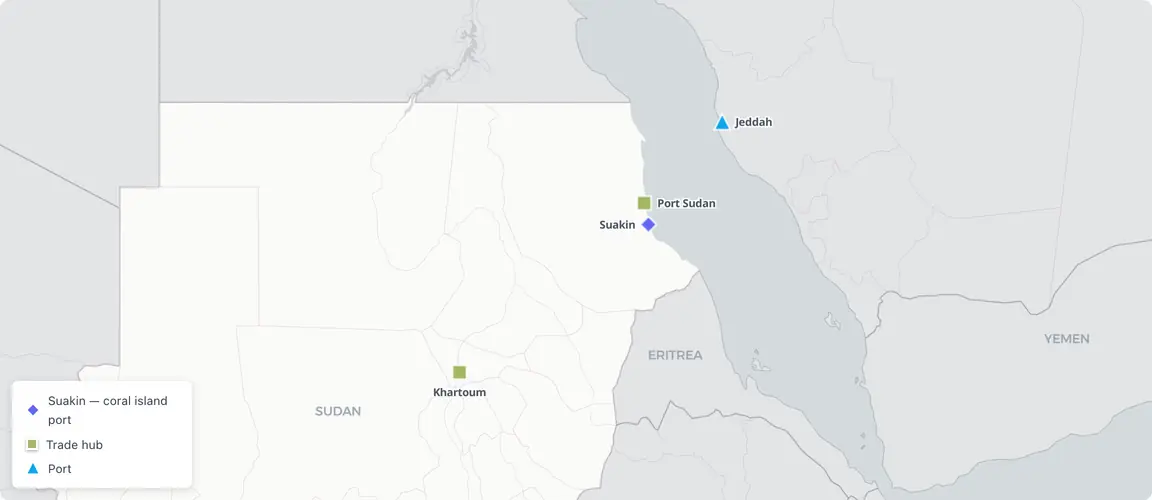
Geographic context: Suakin and the Red Sea trade corridor
Trade timeline
A British civil engineer named Stewart Newcombe arrived at Suakin in October 1901 to assess the harbour. He measured the lagoon, noted the silting, and found the bay hemmed in by coral reef. The lagoon entry was too narrow for modern steamers. His conclusion: the harbour was mediocre. He recommended a different bay, 58 kilometres north. The administration agreed. Suakin was never officially told.
The island that answered to every empire
Suakin had been earning this moment for nine centuries. The Arab geographer al-Hamdani described it in the 10th century as “already an ancient town.” The Beja and Hadendowa tribes made it their interface with the sea; the Funj Sultanate of Sennar used it as their Red Sea outlet from 1504 onwards. In 1541, a Portuguese chronicler compared the island to Lisbon: “so dense that there is no corner without a building… All the city is an island and all the island is a city.”
The Ottomans formalised the arrangement in 1555. Özdemir Pasha established the eyalet of Habesh with Suakin as its coast-facing anchor, and what the Ottoman governors improved across the following century was a city in the specific Red Sea vernacular: coral-block houses (madrepore, a local reef material) two to four storeys high, lime-faced, with mashrabiyas — projecting wooden lattice screens — and roshans giving onto streets narrow enough to keep out the midday sun. Java teak framed the windows. Mangrove supported the floors. The building material was structurally sound — this Red Sea idiom persisted for centuries in Jeddah, Massawa, and Mocha — but it required maintenance. The monsoonal humidity attacked the lime facing within years of application; without re-plastering every two to three years, the coral matrix began to delaminate. The merchants who paid rent for their warehouse space paid, incidentally, for that lime. Nobody tracked this linkage.
The Hajj corridor made Suakin structurally vital. The Swiss traveller Johann Ludwig Burckhardt, passing through in 1814, counted roughly 500 West African pilgrims crossing annually via the Shendi route on their way to Mecca. J.F.E. Bloss, writing in Sudan Notes and Records in 1937, called Suakin “the main port for Sudanese and West African pilgrims.” Pilgrim flows were identity-based rather than commodity-based — they depended on faith, not price, and they persisted through commercial disruptions that commodity trade could not survive.
By the time Khedive Ismail of Egypt received Suakin from the Ottomans by firman in 1865, the port was a mature commercial centre. Ismail invested in the upgrade: mills, hospitals, a Coptic church, a causeway connecting the island to the mainland at Geyf. The Suez Canal, opening in 1869, multiplied Red Sea traffic. The trade volume reached approximately £1,000,000 annually by 1875 — gum arabic, cotton, sesame, hides, and livestock moving north; European imports moving south. The coral warehouses stood. The rents were paid. The lime was maintained.
The war Suakin survived
In 1883, Muhammad Ahmad ibn Abd Allah declared himself the Mahdi — the guided one — and launched an uprising that cut Suakin off from its Sudanese hinterland for fifteen years. Baker Pasha’s Egyptian force was destroyed at El Teb in February 1884. The British landed Royal Marines to secure the port; General Graham’s first Field Force of 4,000 men arrived that March. Trade collapsed. Exports fell from £127,263 in 1883 to £4,625 in 1885 — a 96 per cent decline in twenty-four months.
The proposed solution was a railway. In February 1885, the firm of Lucas and Aird contracted to build 280 miles of track from Suakin westward to Berber on the Nile. They completed 20 miles before the Panjdeh crisis — a confrontation between Britain and Russia over an Afghan border village — reordered British strategic priorities and cancelled the Sudan intervention. The contract was terminated in May 1885. Track and rolling stock were returned to the Royal Arsenal at Woolwich. Cost: approximately £865,000, or £45,000 per mile of track that would carry no cargo and no passengers. Twenty miles of earthwork and rail in the desert, stranded outside the city, demonstrating that half-built infrastructure is worse than none.
Suakin survived the war. Kitchener’s reconquest of Sudan in 1898 reopened the hinterland. British steamers calling at the port rose from 9 in 1890 to 44 in 1896. Gum arabic moved again. Pilgrims resumed their crossings to Jeddah. A merchant arriving in 1900 would have found a functioning port — imperfectly positioned (the harbour silted; the lagoon was tight for the larger steamers the Suez Canal had introduced to Red Sea trade) but functional. The Mahdist War, which should have been the existential crisis, had proved to be a serious interruption. Suakin absorbed it and recovered.
This survival was, in retrospect, the misfortune. A destroyed port forces a decision: rebuild here, or elsewhere? Suakin’s recovery from the Mahdist War kept that question formally open. It would remain open until October 1901, when Stewart Newcombe arrived with his measuring instruments.
After the reconquest, the Sudan administration needed a railway connecting Khartoum to the Red Sea coast. The obvious terminus was Suakin — the existing port, the known harbour, the city that had been handling Red Sea trade for centuries. The question was whether the obvious choice was the right one.
Fifty-eight kilometres north
Newcombe’s assignment in October 1901 was to assess the Berber–Suakin route. He came to Suakin, measured the harbour, and arrived at his professional conclusion: mediocre. The lagoon entry was too narrow for loaded steamers at low tide. The harbour silted at rates that dredging could not sustain. The bay was hemmed in by the same coral reef that had once protected the city from naval assault — protection that was now a commercial liability.
Newcombe surveyed north. At Mersa Sheikh Barghut, 58 kilometres up the coast, he found what the Sudan administration needed: a deeper bay, a wider entrance, a more navigable channel. He filed his report. The Sudan Railway Committee approved the northern route in 1902.
The first train from Khartoum reached what was being called Port Sudan on 16 October 1905; by year-end, the line was extended to the new harbour site. The customs house at Port Sudan opened in May 1906. Goods volume in the first year: £470,000.
What followed required no edict. No official order closed Suakin. No declaration of redundancy was published. Shipping lines made their own calculations: a vessel that could dock at Port Sudan’s purpose-built quay, clear customs there, and load directly onto the Khartoum railway had no reason to make the additional 58-kilometre detour south to Suakin’s cramped lagoon. Wholesalers moved their agents. Merchants relocated their offices. Government departments reorganised their logistics. Each actor made an independent decision. The decisions happened to be identical.
By 1909, when the full Port Sudan harbour was complete at a total government expenditure of £E914,320, Suakin was handling approximately 63 per cent of Sudan’s imports. The port had not been closed. It had not been attacked. It was still open, still clearing customs, still moving goods through a lagoon that still held water. It was handling nearly two-thirds of the country’s import traffic.
And it was already functionally dead.
The mechanism is precise and worth holding. Port Sudan was not built to destroy Suakin. It was built because Suakin’s harbour was mediocre and a better one was available 58 kilometres north. Once that harbour existed, every actor in the supply chain — shipping lines, customs officials, wholesalers, government departments — made an independent calculation and arrived at the same answer. No coordination was required. No conspiracy was needed. The commercial logic pointed north, and commerce followed.
The 1900 Suakin merchant who, in that year, optimised his warehouse — added a roshan, replaced the Java teak doors, repointed the coral-lime — was perfectly rational. He was also perfectly doomed. His warehouse metrics were fine. His occupancy was sound. The port was clearing goods. The thing that condemned him was not visible inside his warehouse; it was Newcombe’s survey report, describing a different bay 58 kilometres north as marginally better than his.
The question the merchant could not have known to ask was not “is my port still working?” — it was. The question was: is the infrastructure my port depends on still the infrastructure that new customers will use? By 1906, the answer was no. The shipping lines had made their calculations. The customs functions had migrated north. The railway terminus was elsewhere. The merchant’s working warehouse sat at the end of a 58-kilometre detour that every rational actor had already decided to avoid.
The coral’s maintenance bill
The physics of madrepore construction are mundane and catastrophic in combination. Reef coral cut into blocks and set with coral-lime mortar is structurally sound — Jeddah’s coral buildings survived for centuries — but the lime facing must be renewed every two to three years against the Red Sea’s humidity and salt wind. Without that renewal, the soft coral matrix begins to delaminate from the inside out. The process is slow at first, then rapid.
For four centuries, Suakin’s maintenance regime was underwritten by the rents paid for warehouse space. No one had ever separated these cash flows because there was no reason to: the port had been commercially active since the Ottoman era, and active ports maintain themselves through the ordinary mechanism of landlord incentive. The lime was applied because the merchants were there. The merchants were there because the trade was there.
When the trade migrated north, the maintenance regime lost its funding source.
The institutional withdrawal followed a sequence that David Roden documented in Sudan Notes and Records in 1970. The National Bank of Egypt closed its Suakin branch in 1923. The Eastern Telegraph office closed in 1924. The school closed in 1927. Each closure removed people with reason to maintain a presence on the island, which reduced the rents that financed building maintenance, which accelerated the delamination, which reduced the number of buildings worth maintaining. The sequence was self-reinforcing. Each departure made the next departure more rational.
By the late 1930s, the island was effectively deserted. The wharf had collapsed into the lagoon. The docks had silted into shoals that excluded all but the smallest vessels. Michael Mallinson’s NCAM-Cambridge-Ulster archaeological project, working at Suakin from 2002 to 2010, documented that by the early 2000s all the historic coral-block buildings lay in ruins. Buildings that had stood since the Ottoman era dissolved in six decades. Not because coral is fragile. Because the maintenance regime that kept it sound had lost its income.
The lesson is not about coral. It is about any physical infrastructure — a building, a server farm, a logistics hub — that depends on operational cash flow to survive. The fragility is structural, not technical. Suakin’s warehouses stood for centuries not because coral is durable — it is moderately so — but because the trade that used the warehouses paid for the maintenance that kept the coral sound. When the trade stopped, the buildings did not disappear immediately. They stopped being maintained. Then, at the speed of their maintenance regime, they dissolved.
What Newcombe’s survey couldn’t see
Most disruption stories have an attacker. The Christensen-style new entrant climbs the technology stack. The regulatory shock removes the incumbent’s advantage. The Chinese manufacturer cuts the price below sustainable margins. Suakin had no attacker. The British Empire was Suakin’s longest-serving patron: it landed Royal Marines in 1884, built jetties, garrisoned the city through the entire Mahdist War, and surveyed three separate railway routes including one that terminated at Suakin itself. Then, on engineering merit alone, it chose a different bay.
The lesson is not disruption. It is irrelevance. Infrastructure competition does not damage existing systems while they are still working — it makes “still working” worthless. Suakin’s working port was not attacked; it was bypassed. Bypassed infrastructure does not fail all at once. It dissolves at the speed of the maintenance regime that can no longer fund it — coral lime in monsoon air: slowly, then all at once.
Newcombe’s survey recorded a harbour’s dimensions. What it could not record was the maintenance regime that harbour funded, or how fast that regime would unwind once the trade it depended on moved 58 kilometres north. The instrument measured silt and reef; it had no gauge for rent flows, lime cycles, or the sequence of institutional withdrawals that followed.
Suakin in 2026 sits in territory controlled by the Sudanese Armed Forces, which since April 2023 has lost central Sudan to the Rapid Support Forces and relocated the national government to Port Sudan — the harbour that condemned Suakin in 1906, now the seat of government. The Turkish 99-year restoration lease, signed in 2018, remains formally in force but has been dormant since President Bashir’s fall in 2019. The SSLH association, led by engineer Ahmed Bushra and architecture student Doha Abdelaziz Mohamed, continues coral-block restoration under British Council and UNESCO funding despite the active conflict.
The ruins stand. The coral continues dissolving. Port Sudan handles the cargo.
Newcombe was right about the bay. He just couldn’t see the ruins his report would make. The 1900 merchant couldn’t have seen them either — which is precisely the lesson Suakin is still teaching.
Researched 18 sources in English.