 Skip to main content
Thailand Tea & Coffee: Beneath the Canopy
Tan Passakornnatee's Green Factory — 2,000 square metres scheduled to open in November 2011 — was submerged for two weeks by the Ayutthaya floods. He rebuilt it, converted the disaster perimeter into a learning center, and listed on the SET three years later. No database recorded what he survived before Ichitan became Thailand's largest RTD tea brand.
Thailand tea & coffee: the 700km supply chain
What the crises kept making
In November 2011, a brand-new 2,000-square-metre cold aseptic filling line — scheduled to open in one month — disappeared under the Ayutthaya flood waters. Tan Passakornnatee, who had spent fifteen years building his way out of personal bankruptcy after the 1997 Asian Financial Crisis and then founding Ichitan from scratch, stood at the edge of his submerged factory and made a decision. He rebuilt it. He converted the disaster perimeter into an environmental learning center he named Tanland, and opened it to school groups from across Ayutthaya province. In April 2014, Ichitan listed on the Stock Exchange of Thailand. Within twelve months, it was Thailand’s largest ready-to-drink tea brand — in a category that had not meaningfully existed four years earlier.
No market intelligence database recorded what Tan survived before that listing ceremony. And that is Thailand’s tea and coffee problem in miniature: the founders who built this sector are systematically invisible to the analysts who cover it.
What the databases miss
We didn't want the farmers to supply us — we wanted them to own with us. That changed everything about how we run the company.
Three overlapping barriers make Thailand’s founder-owned tea and coffee cohort invisible to institutional capital.
The first is state-chain canopy. Café Amazon — operated by PTT Oil and Retail Business — runs approximately 4,900 outlets across Southeast Asia, making it one of the region’s largest coffee chains by location count. Inthanin, owned by Bangchak petroleum, runs roughly 700 outlets. Café Phunthai, backed by PTG Energy, is targeting 5,000 outlets by 2028. These are petrol-station amenity plays by state-linked energy companies, and they command every aggregate market-share report. When analysts cover “Thai coffee,” they see the state chains. The founder-owned cohort disappears into the footnotes.
The second barrier is revenue opacity. Eight of the ten most viable founder-owned brands are privately held, unlisted, and documented only in Thai-language corporate registries. No English-language investor disclosure, no DBD audit transparency equivalent to SEC filings, no sell-side coverage beyond analysts at the one listed company, Ichitan. Revenue estimates require triangulating outlet counts, production tonnage, and import filings. No public database has done this work.
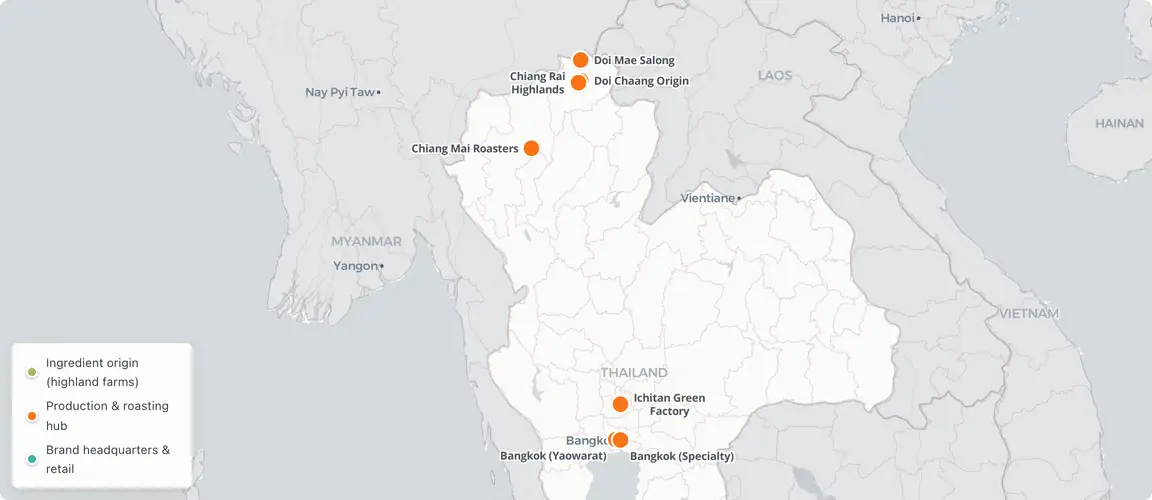
The third barrier is geographic fragmentation. Production is concentrated in three northern provinces — Chiang Rai, Chiang Mai, and Nan — at 1,200 to 1,400 metres altitude, 700 kilometres from Bangkok. Arabica and oolong farms near the Myanmar border supply specialty roasters in Chiang Mai and industrial cold-fill lines in Ayutthaya. Brand headquarters and consumer retail are 700 kilometres south, in Bangkok’s Yaowarat Chinatown or the Thonglor and Ekamai specialty clusters. The supply chain is real, documented in trade statistics, and traceable through farm cooperatives to franchise contracts. It has never been mapped in an English-language intelligence product.
The survivors
The founders who built this sector through its hardest moments left a different kind of record — one that requires specific documentation to find.
Ichitan — Tan Passakornnatee’s story begins not in 2011 but in 1997. The Asian Financial Crisis destroyed his real-estate portfolio — an estimated ฿100M THB or more in personal debt, by subsequent accounts. He sold almost everything he owned and spent two years clearing it. Then, after a conversation about an American flat-price buffet model he’d observed while traveling, he launched Oishi Buffet in Bangkok in 1999. The restaurant grew into Oishi Group, which he later sold to ThaiBev. The exit was not a wind-down — it was a reposition. Tan had observed that Thailand’s packaged beverages market, dominated by carbonated drinks and energy drinks, had no meaningful RTD tea presence at industrial scale. Ichitan Group, founded in 2010, was built specifically for that gap. The Green Factory in Ayutthaya was a cold aseptic filling line designed to produce tea at the volume required for nationwide distribution in a category that did not yet exist.
The 2011 flood was the second crisis in fourteen years. The Ayutthaya floods were Thailand’s worst in seventy years, affecting 65 provinces and causing an estimated ฿185B THB in industrial damage. Tan’s brand-new factory absorbed two weeks of floodwater before it had produced a single unit. The Green Factory reconstruction took two years, during which Tan converted the disaster perimeter into Tanland — an environmental education center he opened to school groups from across Ayutthaya province. The reframe was precise: a factory that floods had closed became a factory that learned from floods and opened a classroom. Ichitan listed on the SET in April 2014. Within twelve months it was Thailand’s largest RTD tea brand. In August 2014 — four months after the IPO — Ichitan executed a joint venture in Indonesia with Mitsubishi Corporation and PT Sigmantara. A Philippines distribution partnership with Rebisco followed in August 2022. Tan holds approximately 27.74% of the company as of 2024. He built a category that did not exist, inside a flood, and turned it into a two-country export architecture in eight years.
As a listed company, Ichitan also carries the governance scrutiny the private brands escape — visible precisely because the Thai-language record is dense around it. Form 56-1 filings trace revenue from ฿5.25B THB in 2021 to ฿8.59B in 2024, with RTD green-tea market share rising to 34% by 2024; the company set a ฿9.5B target for 2025. That paper trail also records the friction: the SEC opened a civil enforcement action against Tan’s spouse, Ing Passakornnatee, and two others for insider dealing in ICHI shares, and the group dissolved a subsidiary, Ichitan Power, effective November 2024. None of this appears in the English-language coverage — which is the point. Listing buys transparency, and transparency surfaces both the growth and the governance events; the eight privately held brands disclose neither.
Hillkoff — The crisis that tested Hillkoff came from commodity markets, not natural disaster. In 2001, a global collapse in coffee prices drove the company — then a small Chiang Mai roaster founded by Theera Taksa-udom — into financial crisis. Theera made a decision that is now the cleanest documented succession in Thailand’s founder-owned coffee sector: he gave his daughter Naruemon his last roaster and his last bags of beans, and stepped back. She was a lecturer at Payap University. She quit.
Naruemon traveled to Bangkok alone and rebuilt the customer base from nothing, rebranding the company as Hillkoff along the way. Recovery took five years. What she built after that is what a database would eventually find, if it looked: 1,000 tonnes of green coffee processed per year; sourcing relationships with 900 farming households across eight northern provinces; a 2017 gold medal at the India International Drinks Challenge; a 2024 Thai National Good Governance Award for circular economy practices.
The model Naruemon built around the crisis is worth understanding as a system. Hillkoff sources directly from smallholder farmers in Chiang Rai, Chiang Mai, and six other northern provinces, bypassing commodity markets through direct-trade relationships that invest yield premiums back into farm certification and community development. That architecture is what earned the governance award — and it is also what made the COFFOGENIC sub-brand viable. Hillkoff registered COFFOGENIC across eight countries through the WIPO IP Management Clinic, protecting a premium positioning that could not have been built from a commodity purchasing desk.
The transition from Theera to Naruemon happened in 2001. It is the sector’s only fully confirmed, complete generational handoff. Hillkoff has been a second-generation company for twenty-three years. The distance from her father’s last roasters to an eight-country trademark is exactly that long — and it runs through a Bangkok bus ticket and five years of rebuilding from zero.
Doi Chaang — On January 23, 2014, Wicha Promyong died of a heart attack near Doi Chaang village. He was 63 years old. The cooperative he had spent a decade building — converting an opium-growing Akha hill-tribe community at 1,400 metres altitude in Chiang Rai into one of Thailand’s most recognized specialty coffee origins — had no succession plan, no named heir, no written transition document.
Wicha was the business head of three Thai principals; operational leadership did not vanish with him. Panachai Phisailert — the former Doi Chaang village headman who had run the production side — stepped up as managing director of Doi Chaang Coffee Original, and the marketing principal, Pitsanuchai Kaewpichai, stayed on. The Thai-language record shows the strain in the numbers: the holding subsidiary’s revenue, ฿44.9M THB in 2014, fell to ฿4.5M by 2016 in the years after Wicha’s death. What did not fail was the structure beneath it.
Doi Chaang has now operated for more than twelve years without its founder. The governance model Wicha and Canadian co-founder John M. Darch built together has held: 50% of the Vancouver distribution entity is owned by Akha farmer cooperative members, 100% of green-bean proceeds are retained by the farming community, and Wicha’s 30%-of-proceeds reinvestment commitment was absorbed by the Doi Chaang Foundation. The coffee has placed in the top 1% of global coffees reviewed by Coffee Review in assessments documented since 2014, a standing confirmed in the platform’s own coverage of the cooperative. Distribution continues through the UK via DR Wakefield. The “Beyond Fair Trade” framing Darch and Wicha used was precise: in standard fair-trade arrangements, farmers receive a price premium on green beans. In Doi Chaang’s model, farmers own half the distribution entity and retain 100% of the margin on their own crop. The distinction matters because it determines what happens when the founder dies. In a premium-price model, the value lives in the buyer’s willingness to pay it. In an ownership model, the value lives in the equity structure — and equity structures outlast individuals.
What Doi Chaang proves, structurally, is that a founder-less continuation is possible when the governance model outlasts the founder’s presence. Wicha built something that did not require him to keep building it. That is a different credential than institutional backing or franchise architecture — and it is one that no standard market-share report has measured or indexed.
The broader cohort
Beyond these three, a documented cohort extends the sector’s depth.
ChaTraMue, founded by a Chaozhou immigrant family in a Bangkok tea house during WWII air-raid warnings, now runs its retail business through the third generation — Praonarinth Ruangritthidet, known as “Praew,” who founded the operating company Thipthari in 2021 to carry the brand her grandfather started in 1945 and her father, Ditthapong Ruangritthidet, built into a packaged-tea manufacturer. The group’s three subsidiaries reported combined revenue of roughly ฿5.8B THB in fiscal 2024 — Thipthari ฿1.83B, the export arm Cha Thai International ฿3.5B, and the original Siam FB Products ฿470M — with 20–30% annual growth sustained across five consecutive years. It operates 40 or more outlets in Malaysia and has established retail presence in the UK, US, and Philippines. The succession itself is the rare clean one: third-generation control is named, documented, and operational. What is undocumented is whether a fourth generation is being prepared behind it.
Black Canyon was acquired by Pravit Chitnarapong in 1993, when the chain had only four or five outlets and he was leaving a career selling IBM software — he financed the deal by pawning his vehicle and borrowing from friends. He has since built it into more than 280 outlets across eight countries: Singapore, Malaysia, Indonesia, Myanmar, Cambodia, Laos, the UAE, and the Philippines. Pravit is in his early sixties. No successor has been publicly named. The company’s international architecture is the sector’s most extensive documented export footprint. What happens at the succession event — acquisition, management buyout, or family continuation — will determine whether that footprint is leveraged or fragmented.
Akha Ama Coffee, founded by Lee Ayu Chuepa, has earned BBC and Wall Street Journal profiles for its hill-tribe cooperative model in Chiang Mai’s Nimman neighbourhood. Lee Ayu, an Akha community member from the same highland belt as Doi Chaang, built a direct-to-consumer brand in the city that made his community’s origin visible to international coffee buyers. Sub-threshold for institutional engagement by revenue, its founder narrative is among the most internationally visible in the cohort — and its geographic story is the 700-kilometre supply chain told from a single producer’s perspective.
Two specialty-sector anchors hold the Bangkok end: Roots/Kinnest (Varatt Vichit-Vadakan), which executed a COVID-era pivot to 100% Thai-sourced beans across its café and roastery network; and Ristr8to/Roast8ry (Arnon Thitiprasert), whose founder won the 2017 World Latte Art Championship and whose flagship defines Bangkok’s specialty coffee scene. Together they represent the demand-side anchor of the same supply chain that begins in Doi Mae Salong — when Bangkok’s specialty cafés source Thai-grown beans, they close a loop that runs 700 kilometres north to the highland cooperatives that no English-language database has indexed or measured.
The cohort is heterogeneous in scale and maturity. Ichitan is a listed company with confirmed institutional partnerships across two export markets. ChaTraMue is a century-old family structure with a proven Malaysian franchise network. Black Canyon is an operationally mature international chain with no publicly named successor. Akha Ama, Roots, and Ristr8to are specialty-segment operations with high international media visibility but without institutional ownership architecture. This range means there is no single entry point. What exists instead is seven distinct stories with different risk profiles, different time horizons, and different investment engagement formats.
Four succession states, one sector
The succession and export evidence across this cohort converge on the same conclusion.
The succession signal is specific. ChaTraMue’s third generation runs the retail business through a named, documented operating company, with the fourth generation not yet visible behind it. Hillkoff completed its handoff in 2001 — twenty-three years of post-founder operation, the cohort’s only fully documented clean succession. Doi Chaang has operated twelve years without a founder and remains financially viable. Black Canyon has a founder approaching his mid-sixties with no named heir. These are not generic aging-founder observations. They are documented states with different risk profiles, in a single sector, maturing on different timelines.
The succession states carry different structural weight. Hillkoff under Naruemon is a stable platform — the succession event is twenty-three years in the past, governance is clear, and the direct-trade architecture is scalable. ChaTraMue is a dynasty with an active third-generation operator and proven international franchise architecture; whether a fourth generation is being prepared behind Praonarinth Ruangritthidet is undocumented. Black Canyon is the sector’s clearest open question: no successor has been named for a founder in his sixties running an eight-country franchise network.
The export signal is concrete. Black Canyon operates in eight countries. ChaTraMue has 40 or more Malaysian outlets plus UK, US, and Philippines retail. Ichitan executed an Indonesia joint venture in August 2014 and a Philippines partnership with Rebisco in August 2022. Doi Chaang distributes in Canada and the UK. The infrastructure for cross-border distribution exists across multiple brands. It was built before any English-language intelligence platform documented it.
The record was never hidden
The 700-kilometre supply chain that no database has mapped was built by specific people making specific decisions under pressure. Tan Passakornnatee rebuilt his factory inside a flood and converted the disaster line into a classroom. Naruemon Taksa-udom took her father’s last roasters to Bangkok and spent five years rebuilding what the commodity markets had destroyed. Wicha Promyong built a governance model that has now outlasted him for twelve years.
The crises that forced these founders to innovate are the same credentials that no market-share report has indexed. And the cohort that survived is already exporting across eight countries.
Seven brands, one 700-kilometre chain, decades of Thai-language filings — a record kept the entire time, in a language most databases never read.
Researched 73 sources in English, Thai.