 Skip to main content
A disputed territory the size of Delaware once supplied 10.4% of Russia’s wine imports. By 2025: 1.75%. An excise shock halted the dominant producer. Georgian and Chilean wines seized the vacated shelves. Yet a handful of boutique producers — working with 4,000-year-old grape varieties no competitor possesses — are proving that quality Abkhazian wine can compete. The sector that survived total war now faces a subtler threat.
This report exists because Brandmine reads Russian-language trade press and production documentation from a territory that doesn’t appear on standard commercial databases. We are publishing it as a complimentary first edition — documenting markets like this is exactly what Brandmine was built to do.
The report below tells you what the sector looks like, brand by brand.
What This Report Contains
Sector Panorama
The complete verified landscape of a market that doesn’t appear on standard maps. Every significant wine operation in a territory of 250,000 people — five producers and one distributor — verified through Russian-language trade press, production documentation, and direct web presence.
- Signals readiness — which of the 6 brands are export-ready, scale-ready, or approaching succession
- Verified directory of 6 brands — ownership, production scale, and growth-signal status; from Wines and Waters (28M bottles) to Argun Iashta (5–10K bottles of exclusively dry wine)
- Two founder spotlights — Beslan Agrba, who built Russia’s sole Abkhazian wine import monopoly through the ruble crisis, and Nikolai Achba, who rebuilt Wines and Waters from wartime rubble to 28 million bottles
- 2025 rankings — the brands ranked by revenue and production scale
- Distribution architecture — Mistral Alko’s exclusive import monopoly, 50% co-ownership of the republic’s largest producer, and what that structure means for any partner entering this market
- Market access — the recognition constraint, the Russia-only channel reality, and the 2024 tariff windfall that rewarded thirty years of persistence
- Market Intelligence Summary — ownership structure, business models, production scale, and brand attributes across all 6 brands
- Brandmine resilience framework — the lens we read every brand through: the six-phase story arc and the dimensions that classify them
- Sector story & century-long timeline — the two-track industry (semi-sweet volume vs. artisan dry), indigenous varieties confirmed genetically distinct by DNA study, and the arc from Soviet peak through wartime destruction to the 2024 tariff windfall
What You Receive
A 34-page report delivered as a printable PDF in English, Russian, and Chinese — all three editions available for download above. Bundled with a structured data file (CSV + Excel).
This Sector Panorama is complimentary. No purchase required.
Research Standards
Brandmine investigated the complete commercial landscape of Abkhazia’s wine sector — five producers and one distributor — through Russian-language primary sources including trade press, production documentation, and direct web presence. All six brands survived the 1992–1993 war or were founded by people who did. Brandmine has no commercial relationship with any brand in this report.
Available for this sector:
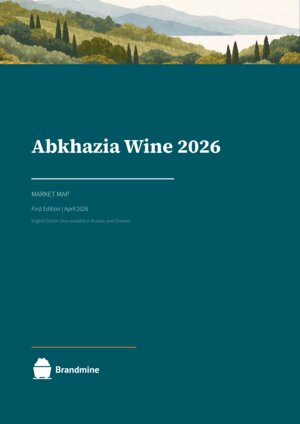
Sector Panorama
First Edition · March 2026 · 34pp
- Printable PDF report — 34 pages
- English, Russian, and Chinese editions — all three available for download
- Companion data file — CSV and Excel
- Complimentary — no purchase required
Free