中文版暂未上线,当前显示英文内容。
韧性品牌
Love a Loaf Bakery & Cafe

Love a Loaf Bakery & Cafe

, 槟城 🇲🇾 创始人所有 · 垂直整合

A French-inspired Penang bakery that markets itself as halal-friendly scaled where almost no café follows — inside the canteens of Intel, Jabil and Dell, hospitals and hotels. The key to those captive sites was a position, not a recipe — and no federal certificate sits on the register. Fourteen-plus outlets later, the position is the moat.

成立时间 2014 (self-taught founder opened after his hired baker walked)
营收 ~RM18–25M MYR (~$4–5M USD, estimated across the group)
规模 14+ owned outlets · Northern Malaysia + Bangkok
独特优势 Halal positioning as distribution — captive factory and hospital sites a pork-serving café can't reach, though no federal certificate is registered.
生产 Own bakery production · imported NZ/French butter · daily fresh bake
出口 1 Bangkok outlet (partner-funded; status unconfirmed)

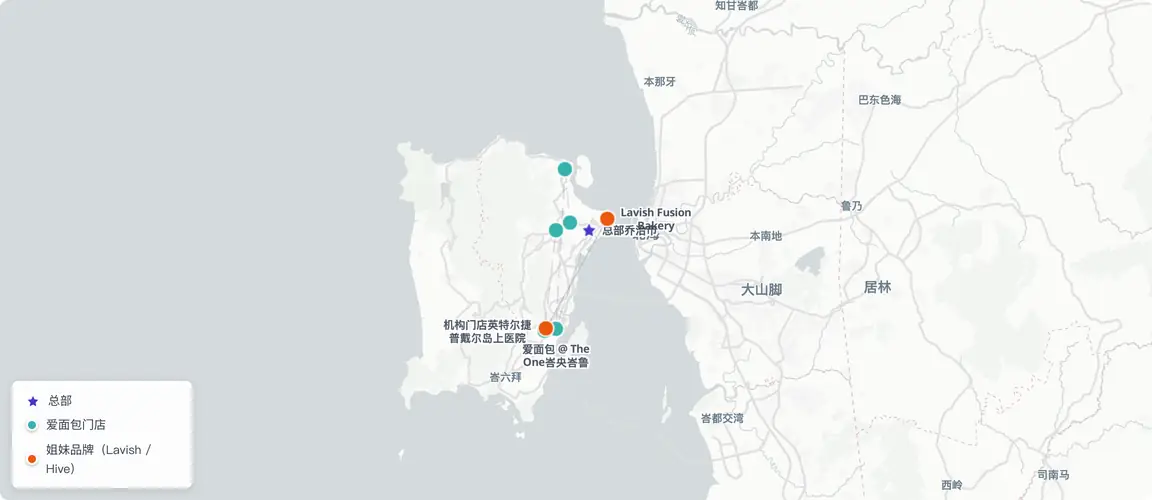
槟城工业北区逾十四家门店

总部
爱面包门店
姐妹品牌(Lavish / Hive)

Winning captive channels a certificate never opened

2013-07-29 背景 — 2013-07-29
完整时间线请参阅报告
背景
2013-09-01 危机 — 2013-09-01
完整时间线请参阅报告
危机
2014-03-01 First outlet opens
Love a Loaf opens its first store at The One, Bayan Baru/Bayan Lepas, in Penang's industrial-suburb belt.
催化剂
2014-12-16 背景 — 2014-12-16
完整时间线请参阅报告
背景
2015-06-01 挣扎 — 2015-06-01
完整时间线请参阅报告
挣扎
2016-06-01 突破 — 2016-06-01
完整时间线请参阅报告
突破
2016-11-20 Lavish Fusion Bakery launches
Sister café Lavish Fusion Bakery opens in George Town's heritage zone — a pork-serving fusion concept deliberately distinct from the halal-positioned parent.
突破
2017-07-05 Oriental Daily feature
Oriental Daily profiles the brand at five outlets — four in Penang, one in Thailand — documenting the 'light travel' café concept.
胜利
2018-01-01 突破 — 2018-01-01
完整时间线请参阅报告
突破
2019-01-01 突破 — 2019-01-01
完整时间线请参阅报告
突破
2020-03-01 危机 — 2020-03-01
完整时间线请参阅报告
危机
2021-02-02 挣扎 — 2021-02-02
完整时间线请参阅报告
挣扎
2021-03-01 危机 — 2021-03-01
完整时间线请参阅报告
危机
2022-01-01 突破 — 2022-01-01
完整时间线请参阅报告
突破
2025-01-01 14+ outlets across Northern Malaysia
The brand reports over 14 retail stores across Northern Malaysia, with sites at Intel, Jabil and Dell factories, Island Hospital, Citadines hotels and Caltex stations.
胜利

Most bakeries scale by opening on high streets and in malls, where foot traffic is public and contested. Love a Loaf scaled by going where almost no café follows — inside the factories, hospitals and hotels of Penang’s industrial north — and it got through those gates not with a recipe but with a position: a French-inspired bakery that markets itself as halal-friendly.


Love a Loaf Bakery & Cafe · 成立于 2014 · Bayan Baru, Malaysia

The gates a recipe couldn’t open

That distribution paradox is the whole argument. Malaysia’s bakery-products market is large — roughly RM20.64bn in 2024, per a Protégé Associates market study filed with Bursa Malaysia — but it is shaped at the top by national manufacturers like Gardenia and, in the café tier, by franchise machines like Rotiboy, which has pushed past 200 outlets on a licensing model. Love a Loaf is neither. It is a regional specialist, not a national producer, and it took a different road to scale than the franchise route its peers ran. It stayed owner-operated, kept every outlet on its own books, and pointed its growth not at the open high street but at captive channels — the canteens and lobbies of Intel, Jabil and Dell factories, Island Hospital, Citadines serviced apartments, Caltex forecourts.

The thing that makes those sites winnable is positioning, not pastry. A bakery that credibly presents itself as halal and Muslim-friendly can feed a Malay-majority workforce that a pork-serving café simply cannot. Love a Loaf understood early that in a market where the majority community keeps halal, the brand that reads as accessible to that community captures a kind of distribution its rivals are structurally locked out of. Where Rotiboy competes on franchise density and Gardenia on supermarket-shelf ubiquity, Love a Loaf competes on breadth, ambience and that accessibility — owned, not licensed. It built a 14-plus-outlet group across Northern Malaysia on that insight — a quiet lesson in how an emerging-market consumer brand can turn a cultural position into a commercial moat.

A bakery built by a man who couldn’t bake

Love a Loaf began, as many good Penang businesses do, with a founder who taught himself the trade. Vincent Tan Yi Heng (陈毅恒) — not to be confused with the Berjaya billionaire of a similar name — set out to build a bakery-café in the Bayan Baru and Bayan Lepas belt, the dense industrial suburb where the island’s electronics multinationals cluster their plants. He registered the company, Love a Loaf Bakery & Cafe Sdn Bhd, in July 2013. The name itself took some arriving at: Tan and his collaborators first wanted something with “Bread” in front, in the Rotiboy idiom, but found every variant too common to own. They settled on “Love A Loaf” for its memorability, a small decision that turned out to matter — in a crowded field, a name that sticks is half the marketing budget, as Tan told Oriental Daily in 2017.

Brand identity in those early days was shaped by a co-founder, 纪少鹏 (romanization unconfirmed), named alongside Tan in the 2017 Oriental Daily feature; he is absent from current management listings, and his present status is undocumented. What emerged was a deliberately aspirational café concept — imported New Zealand and French butter, a “no preservatives” promise, a daily fresh bake, and a “light travel” (轻旅游) idea of the bakery as a small experiential destination rather than a grab-and-go counter. The French-inspired range was the point of difference: in a market where the bun-and-bread café tier runs to the cheap and the familiar, a pâtissier-style offer let the brand sit a notch above the roti counter without leaving the mass market behind. The first store finally opened in March 2014 at The One in Bayan Baru, in the industrial-suburb belt where its future institutional customers already worked. That it opened at all was not a given.

The baker walked, the doors opened anyway

The first crisis arrived before a single customer did. Tan had done the hard, expensive part — leased the space, completed the fit-out, built out a bakery — on the strength of a recruited baker who was to run the actual production. With the renovations finished and the ovens in, the baker walked. For a bakery, this is close to an extinction-level event: the founder had a fully built shop and no one who could bake in it. The launch stalled for roughly six months while Tan, self-taught and unwilling to write off the investment, effectively learned to run the kitchen himself rather than fold. The six-month delay was pure burn — rent and fit-out capital with no revenue against it — and the discipline it forced, owning production rather than depending on a single hired specialist, hardened into the company’s operating instinct. The lesson generalised: a business that has already survived losing its one critical specialist tends to design that single point of failure out of its model. When Love a Loaf finally opened in March 2014, it did so as a business that had already decided it would control its own kitchen — and, in time, every kitchen in the network.

The second crisis was systemic. By early 2020 the brand had grown into a small multi-outlet group with two sister concepts — Lavish Fusion Bakery, the George Town fusion café that openly serves pork, and Hive, a pork-free, alcohol-free eatery aimed squarely at the halal mass market. Then Malaysia’s Movement Control Order shut the country’s cafés to walk-in trade. Footfall, the lifeblood of an experiential bakery, evaporated. The group did what survivors did: pivoted to delivery and e-commerce, then used the downturn to prune rather than merely endure it. The Bayan Baru flagship was gutted and rebranded in early 2021, Lavish was re-concepted, and Hive — the most exposed of the three — was closed by 2021. It was a contraction, but a deliberate one: the brand emerged leaner, with its weakest concept cut and its strongest reset, and crucially with its institutional-channel thesis intact.

What the brand carried out of both crises was a model rather than a single lucky site. The founding stall taught it to own production; the MCO taught it that publicly contested footfall was fragile and that captive, contracted, inside-the-perimeter locations were not. The post-pandemic years saw the institutional push accelerate, and it is that — not the original café — that explains the scale.

Owned, not licensed — and positioned, not certified

Love a Loaf is best understood as a vertically-integrated retail operator, not a bakery chain in the franchise sense. It owns and runs every outlet, bakes its own bread and pastries, and extends its reach through wholly controlled sister brands rather than licensees. By mid-2017 the brand was already at five outlets — four in Penang and one in Bangkok — and the legal scaffolding had thickened to match: a second corporate entity was incorporated in December 2014 as the network grew beyond the original company. Lavish and Hive are not separate companies courting separate owners; they are instruments of one group, each pointed at a different segment of the same market. That structure — owned production, owned outlets, owned sister brands — is the platform on which the real engine sits, and it is what lets the group calibrate its halal positioning concept by concept rather than franchising the decision away.

The engine is positioning as distribution. The brand markets itself as halal and Muslim-friendly, and that self-presentation is precisely what unlocks the captive institutional sites — the factory canteens, the hospital lobbies, the hotel and petrol-station forecourts — that serve a Malay-majority workforce and visitor base. A café that cannot credibly read as halal cannot bid for those sites at all; the position is the entry ticket. The honest complication is that this is positioning, not certification. No MS1500/JAKIM halal certificate could be located on the public register under either of the brand’s confirmed legal entities as of June 2026; a MYeHALAL register lookup returned no entry. The halal-friendly claim, in other words, rests on the company’s own marketing across its website and social channels rather than on a verifiable federal certificate. Register silence is not proof of non-compliance — it establishes neither certification nor its absence — but it does mean the moat here is a credible position rather than a stamped document.

The contrast inside the group sharpens the point. While the parent brand and Hive market themselves to the halal mass market, the group’s own Lavish Fusion Bakery openly serves pork in George Town. One operator runs both a halal-positioned bakery and a pork-serving café, segmenting by concept rather than by company — a structure that would be hard to reconcile under a single federal halal certification, and that makes more sense read as positioning calibrated outlet by outlet. Underneath the positioning sits a genuine product: imported NZ and French butter, the “no preservatives” promise, the daily fresh bake, and a French-inspired range that lets the brand command a café premium rather than a roti-counter price. Group revenue is not published anywhere; triangulating from roughly 14 outlets and two sister brands yields an estimate of RM18–25M ($4–5M USD), and that figure should be read strictly as an estimate, not a disclosed number.

Where the next loaf is already sold

The forward path is the institutional one. Each captive site is a contracted, weather-proof revenue stream insulated from the high-street footfall that the MCO showed to be fragile, and the brand’s halal positioning is the repeatable key that opens the next factory, hospital or canteen tender. By 2025 the model had carried the group past 14 owned outlets across Northern Malaysia, with named anchors at Intel, Jabil and Dell, Island Hospital, Citadines and Caltex — a roster that reads less like a café chain’s and more like an industrial-services supplier’s. The constraint on the thesis is the same as its strength: it depends on a position that is marketed rather than certified, and a future tender requiring formal MS1500 documentation could test it. The overseas line is thinner still — a single Bangkok outlet, Love A Loaf Thailand, opened in 2016 with an equity partner’s money, whose current operating status could not be confirmed and should not be assumed to still trade.

It is worth closing on how little of this brand surfaces in the formal record, because that thinness is itself part of the picture. For a founder-owned group of this size, Vincent Tan’s verifiable local-press corridor runs through a single 2017 Oriental Daily (东方日报) feature. Penang’s Chinese-press heavyweights carry no dedicated profile of the brand, no Malay-language press covers it, and the JAKIM register holds no certificate under its name. That is not unusual for a mid-tier regional specialist — most never clear the bar for a national business desk, and a group of this size and growth would, in a Western market, expect a fuller paper trail. But it is a reminder of how a brand like Love a Loaf is built: in captive channels and on a marketed position, largely below the reach of the formal media and registries that would otherwise document it. The intelligence is in the absence as much as the presence — a 14-outlet group surfacing through a single newspaper feature is itself a finding about how brands hiding in plain sight reach scale without ever quite entering the record.

品牌情报

品牌情报涵盖该品牌的运营与战略基本面。完整情报收录于品牌韧性报告(Brand Resilience Profile)。

标准组成部分

  • 规模 — 营收、产能、分销覆盖及团队规模
  • 市场地位 — 竞争定位与核心差异化优势
  • 认可 — 奖项、评级及行业认可
  • 商业模式 — 商业模式类型与销售渠道
  • 战略背景 — 当前约束条件、战略重点与股权结构