Philippines QSR: the founders who sold their own
Robert Kuan sold his half of Chowking to the rival he once out-franchised and called it a relief — 'the offer was good and it was time to let go.' Edgar Sia sold Mang Inasal to the same buyer for ₱5 billion and became the Philippines' youngest billionaire at 34. In Filipino fast food, the founder's great success is learning when to sell.
菲律宾快餐业:群岛式起源
When selling became the strategy
In 1985 Robert Kuan walked out of his family’s restaurant business after a falling-out and opened a Chinese fast-food counter in Makati. Fifteen years later he had 162 branches, four of them in the United States and three in Dubai, and the Wall Street Journal called Chowking the most successful Chinese food chain in the Philippines. Then he sold his half of it to Tony Tan Caktiong — the man behind Jollibee, the rival whose stores he had spent a decade out-franchising — for ₱600 million, and described the decision as a relief. “The offer was good,” he said, “and it was time to let go.”
That sentence is the closest thing Philippine fast food has to a founder’s creed. The country’s restaurant sector is one of the most founder-dense in Asia — a roughly US$18.4-billion market in 2025 that is still about 74% independent by outlet, held together by people who built brands rather than bought them. And yet the sector’s defining move is not building. It is selling: a generation of founders who created national chains from scratch, then handed them, one after another, to a small set of consolidators. The strange part is that almost nobody has assembled the pattern, even though every individual deal was in the papers.
From an ice-cream parlour to an empire that buys
The offer was good and it was time to let go.
The story begins, as so much of Philippine business does, with a family and a small shop. In 1975 Tony Tan Caktiong and his relatives opened a Magnolia ice-cream parlour in Cubao, Quezon City. Customers kept asking for hot meals; the family added sandwiches and fried chicken, and in January 1978 incorporated Jollibee Foods Corporation. Three years later, in 1981, McDonald’s arrived in Morayta through the local franchisee George Yang, and the conventional advice to the three-year-old Jollibee was to sell out before the American machine flattened it.
Tan Caktiong did the opposite. He studied McDonald’s operations line by line and then bet against them, tuning the menu to the Filipino palate — sweeter spaghetti, seasoned burgers, a fried chicken built for local taste — while the agency behind the brand coined Langhap-Sarap, roughly “aromatic deliciousness,” to reframe the sensory experience as something homegrown. By 1990 Jollibee had 65 domestic stores and had overtaken McDonald’s in its own market, one of the very few countries on earth where the golden arches do not lead. Jollibee today controls around half the local chicken-and-burger market to McDonald’s 29%.
What matters for this sector is what Jollibee did with that victory. Having beaten the foreign giant by being more local, it began, after its 1993 stock-market listing, to consolidate the local field itself. It bought Greenwich Pizza, then Chowking in 2000, Red Ribbon in 2005, and Mang Inasal in stages between 2010 and 2016. Each acquisition sent the same signal to every founder in the country: build a chain good enough and there is a buyer waiting. The “next Jollibee” became a category of ambition — and an exit.
Four islands, one capital
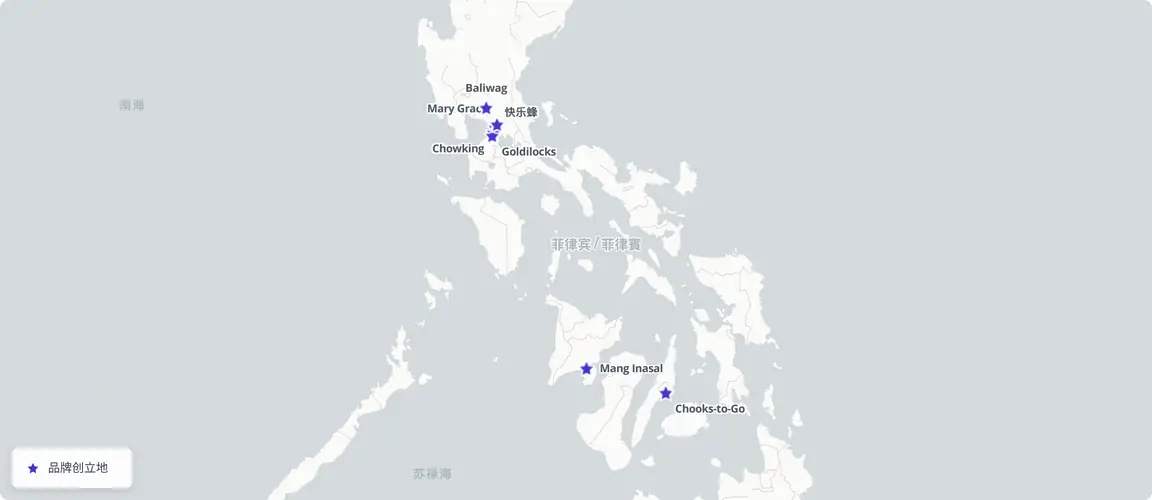
The chains did not come from one place. That is the first thing a map of the sector reveals, and the thing most outside observers get wrong. Quezon City and Makati produced the metropolitan brands — Jollibee, Max’s, Chowking, Goldilocks, Mary Grace — and Metro Manila remains the commercial core, home to roughly 30% of new foodservice establishments and, crucially, to all three of the acquirers that now consolidate the sector. But the country’s most-copied concepts were incubated far from the capital.
Mang Inasal, the chain that produced the sector’s largest founder exit, was born in Iloilo City on the island of Panay, in the chicken-inasal heartland of the Western Visayas, more than 500 kilometres south of Manila. Chooks-to-Go, the vertically integrated roast-chicken brand, ran its early expansion out of Cebu. The roadside lechon-manok tradition — the whole rotisserie-chicken category that Andok’s and Baliwag built into franchises — belongs to the Central Luzon belt in Bulacan and Pampanga, north of the capital. These are different islands, different dialects, different supply chains.
The dispersal is not incidental. It is a consequence of the same fragmentation that keeps the sector three-quarters independent. A Mang Inasal franchise cost roughly ₱800,000 to open in 2003; a food cart costs a fraction of that. Low entry barriers let a founder start almost anywhere. Then 7,000-plus islands raise the cost of a national cold chain, protecting a regional operator long enough to build a defensible brand and a loyal local following before anyone in Manila notices the concept is worth copying — or buying. Hyper-local taste does the rest: Bicol Express, batchoy, the inasal of Panay and the lechon of Cebu resist the standardisation that lets a chain scale flat across a country, so the strongest regional brands grow deep before they grow wide.
The capital is where the money to buy them lives. The provinces are where the things worth buying get made. That division of labour — provincial invention, metropolitan capital — is the sector’s spatial signature, and it is exactly what a reader who assumes “Filipino fast food equals Manila” would never guess from the brand names alone.
What the databases miss
None of this is secret. Every deal in this article was reported, most of them in the business pages of Philippine Star, BusinessWorld, Rappler and BusinessMirror. What is missing is the connective tissue — the recognition that Chowking, Red Ribbon, Mang Inasal, Potato Corner and the Goldilocks stake are not five unrelated transactions but a single machine, and that the machine now runs on three engines rather than one.
There is a second gap, and it is a language gap. The business mechanics — prices, dates, ownership percentages — sit in English. But the reasoning, the part that explains why a founder sells the thing he spent his life building, lives in Filipino. It is in the talambuhay profiles, the GMA documentaries, the community-press interviews where Injap Sia talks about “a father parting with his child” and where the human weight of these decisions is actually recorded. An analyst who reads only the English deal notes gets the arithmetic and misses the sentiment — which, in a sector where the founders are the assets, is the part that predicts the next move.
That is the arbitrage. The intelligence to understand this sector is entirely public, split across two languages and never assembled in one place. It is hiding in plain sight, in the most literal sense: on the record, in print, in a language the people pricing these brands mostly do not read.
Who’s still standing, and who they’re handing to
The founders of Philippine fast food split cleanly into three groups, and the split is the whole story.
The sellers built the pattern. Robert Kuan is its clearest case: a founder who left one family business, built a better one, and let it go on terms he called good, spending his last years on St. Luke’s Medical Center and mentoring his son before his death in 2018. Edgar “Injap” Sia II is its most spectacular. He opened Mang Inasal in Iloilo in 2003 with ₱2.4 million borrowed from his father, grew it past 300 branches in seven years, and sold it to JFC — 70% for ₱3 billion in 2010, the last 30% for ₱2 billion in 2016 — writing to his staff of a “deep sadness” like “a father parting with his child,” even as he called himself “ecstatic” that his “seven-year-old child’s” future was “secured.” He was 34, and the papers called him the country’s youngest dollar billionaire. He put the money into DoubleDragon Properties, co-chaired with Tan Caktiong himself: founder-sold capital recycled into the next venture, the loop closing in plain view.
The channels multiplied. For two decades JFC was the only serious buyer, and it bought through crises as much as through growth. The 1997 Asian Financial Crisis is instructive: the peso devaluation actually slowed Jollibee, shuttering overseas joint ventures in Singapore, Taiwan and Indonesia, even as Greenwich Pizza tripled domestically and JFC opened its first American store. Consolidation in this sector has always run on the same logic — a shock culls the weak operators and hands the survivors, and their buyers, a cleaner field. That logic held again a generation later. In 2018 SM Investments took roughly 34% of Goldilocks — the Leelin sisters’ 1966 Makati bakeshop, now under second-generation leadership — after a full buyout collapsed. In 2022 Shakey’s Pizza Asia Ventures acquired Potato Corner, the flavoured-fries micro-franchise that Jose Magsaysay Jr. and his partners had grown, through 2,000-plus stores across sixteen markets, into an asset worth consolidating. The pandemic did the pushing there: Potato Corner, in the company’s own words, “took a blow” during COVID-19, when the government counted more than 2,000 establishments closed and nearly 70,000 food-service workers displaced. Three buyers now circle where there was one.
The holdouts prove it is a choice. Mary Grace Dimacali turned a home ensaymada business into a formal company in 1994 and built more than 140 cafés and kiosks on a promise of “the goodness of home.” All five of her children work in the business, which remains entirely family-owned, and in March 2026 she opened her first overseas branch — not by selling to a strategic partner but by taking the brand to Tras Street in Singapore herself. The Aristocrat’s Reyes clan and Max’s Trota-Fuentebella families have made the same choice in a slower key, institutionalising four generations of family control rather than cashing out. Their refusal is what makes the sellers’ decision legible as a decision at all.
Beyond the fast-food cliché
It is easy to read all this as a simple story about a hungry conglomerate. It is not. What the Philippine sector actually shows is a culture that treats eating out as a family ritual and homegrown brands as objects of genuine affection — the reason a local chain could beat McDonald’s here and almost nowhere else. When Jollibee opened in Earl’s Court, London, in 2018, the first customer had queued for seventeen hours. There are more than 10.8 million overseas Filipinos, and for many of them a Jollibee or a Chowking or a Goldilocks abroad is not fast food but a taste of home, which is why these brands travel where far larger Western chains stall.
The heritage runs deeper than the fast-food frame suggests. The oldest surviving Filipino restaurant, The Aristocrat, opened in 1936 on a Studebaker van driven by Engracia “Aling Asiang” Cruz-Reyes, and her descendants went on to build Reyes Barbecue and the Mama Sita’s condiment line — a single matriarch seeding a culinary dynasty that outlasted the Japanese occupation of Manila. Max’s Restaurant, born in a Quezon City café in 1945 on a niece’s fried-chicken recipe, is now in its fourth family generation. These are not disposable franchise concepts; they are institutions that happen to sell chicken, and the weight of that history is part of what a founder weighs when a buyer calls.
That affection is also why the founders’ exits carry the emotional charge they do. Selling a chain, in this sector, is not selling a business unit. It is handing over something the founder’s countrymen feel they part-own. Sia’s “father parting with his child” is not marketing; it is an accurate description of what a Filipino founder gives up when the deal closes. The sentiment is the moat, and it is precisely what does not survive translation into a spreadsheet.
Why the next three years decide it
The founder generation that built these chains — Kuan, Sia, Magsaysay, the Leelin sisters, Dimacali, the Reyes and Trota-Fuentebella families — reached their exit decisions across a compressed window, and that window is now open at both ends. On one side, the remaining founder-controlled brands are the obvious next candidates: Chooks-to-Go’s Bounty Agro Ventures, the scaled emerging franchisors, the holdouts who have so far said no. On the other, the buyer market itself is about to be repriced. JFC has signalled an international spin-off and a possible United States listing of its overseas business by 2027, shifting toward an asset-light, franchise-led model — a change that alters what every acquirer in the country can pay and how.
For an investor with Southeast-Asian consumer-brand focus and the patience family transitions demand, the asset is not any single chain. It is the transition itself — the narrow years in which a whole founder-built sector is simultaneously deciding whether to sell, before control settles into second generations or conglomerate balance sheets. For a buyer or franchise partner, it is the operating infrastructure — the central kitchens, the inasal and lechon-manok supply chains, the diaspora distribution — that took decades to build and cannot be assembled retroactively.
The record of how these founders decided sits where it always has: half in English deal notes, half in Filipino interviews, and nowhere in a single institutional database. Robert Kuan’s line — “the offer was good and it was time to let go” — is now a template that Injap Sia, the Magsaysays and the Goldilocks sisters have each followed in their own register. Mary Grace Dimacali has not spoken it, and in March 2026 she answered the question the other way, opening on Tras Street in Singapore rather than selling. But she is one founder, and behind her stand Bounty Agro and a dozen scaled brands whose owners are older every year, in a market where three consolidators are now waiting instead of one. The next Filipino founder to weigh Kuan’s sentence is doing it right now, quietly, in Tagalog — and by the time the deal reaches the English business pages, the choosing will already be over.
跳至主要内容